Prior to 1988, you had to reinvest the profits from selling your home into a new home, but that is no longer the case. As long as you have lived in your primary home for two of the last five years at the time of sale, you are exempt from taxation on your capital gain up to $250,000 (single) or $500,000 (married).
If your spouse dies, you can still get the $500,000 exemption if you sell less than two years after his or her death.
In calculating your capital gain, you take the price of the home when purchased plus any capital improvements (not repairs) made to the home plus the cost of selling (commissions, title insurance, etc.) and subtract that from your selling price. Note: this is my layman’s understanding. Always consult a qualified tax advisor to see how these rules apply in your situation.
Here is a lengthier explanation of the above rules plus some I didn’t mention — sorry I didn’t make note of the source:
The capital gains exclusion for selling one’s primary residence is a tax benefit in the United States that allows homeowners to exclude from their income a portion or all of the capital gain they realize from the sale of their main home, under certain conditions.
Exclusion Amount: Single taxpayers can exclude up to $250,000 of capital gains on the sale of their primary residence, and married taxpayers who file jointly can exclude up to $500,000.
Ownership and Use Test: To qualify for the exclusion, you must have owned the home and used it as your primary residence for at least two of the five years prior to the date of sale. These two years of residency do not need to be consecutive.
Frequency of Exclusion: The exclusion can only be claimed once every two years. That is, you cannot claim the exclusion if you’ve already claimed it on a different home in the two-year period before the sale of the current home.
Partial Exclusion: If you do not meet the Ownership and Use Test fully, you might still be eligible for a partial exclusion if your home sale was due to a change in employment, health reasons, or other unforeseen circumstances specified by the IRS.
Reporting: If the gain on the sale is entirely covered by the exclusion, in many cases you do not even need to report the sale on your income tax return.
Deceased Spouse: If a spouse is deceased, the surviving spouse may still qualify for the $500,000 exclusion under certain circumstances, generally within two years of the spouse’s death.
Remember that tax laws are complex and can change, and individual circumstances can have a significant impact on tax obligations. It’s important to consult with a tax advisor or accountant to understand the potential tax implications of a home sale.
10,000 people reach retirement age every day in the US, and Census statistics show that the “Silver Tsunami” will crest in 2034. More people will be over the age of 65 than under the age of 18. That may be why I am often asked about “reverse mortgages.”
I spoke with one of my preferred lenders, Jaxzann Riggs,recently and was reminded that while most people know that a Home Equity Conversion Mortgage (HECM) can be used to refinance an existing mortgage to access equity, few people realize that a reverse mortgage can also be used to purchase a new home. Fewer people know this because the HECM for Purchase program was not established until 2008.
Prior to 2008, a borrower who wanted to use a HECM as part of their retirement strategy would be required to purchase their new home with a traditional loan and then to refinance into a HECM, doubling the closing costs.
The fundamentals of a HECM refinance and a HECM for purchase are identical. HECMs allow homeowners to access the full amount of their home equity (and, potentially, even more). Borrowers have flexibility regarding how they choose to access their equity. The borrower can eliminate monthly mortgage payments entirely or receive monthly payments from the lender, establish a growing line of credit or they can opt for a combination of all three. Because a HECM is a loan, monthly payments received by the homeowner from the lender are not taxable and do not reduce Social Security or Medicare benefits in any way.
Although they are relatively easy to obtain, reverse mortgages are not for everyone. You must be at least 62 years of age, have substantial equity in your property, and occupy the home as your primary residence. A reverse mortgage also provides security for a “non-borrowing” spouse (younger than 62 years of age), who may continue to live in the home until his or her death following the death of the “borrowing spouse.”
Some of the misconceptions about reverse mortgages that prevent people from considering this option are:
That the lender takes ownership of the home, when in fact, the title stays with the homeowner.
That your family won’t be able to inherit the home when you pass. Any equity that remains from a sale after paying off the mortgage will go to your heirs. If they choose to keep the home, they can refinance into a conventional mortgage.
That you or your heirs may end up owing more than the home is worth. HECM’s are “non-recourse” loans meaning that you or your heirs will never owe more than the home is worth. If you live so long that you exhaust all the equity in your house, FHA insurance covers the loss.
While there are many benefits to a HECM they are not inexpensive. They are “insured” by the Federal government. The “Up Front” premium is 2% of the home’s value and there is an annual premium of .50% of the loan balance (paid monthly). Homeowners pay traditional closing costs as well as an “Origination Fee” which cannot exceed $6,000. While the upfront and annual mortgage insurance premiums may seem steep, they protect you and your heirs from owing additional funds if your loan balance exceeds the home’s value when it is sold. Remarkably, the “note” that you sign for a HECM allows you and your spouse to live in the home for up to 120 years.
The terms offered to a borrower are based upon the age of the youngest borrower and the equity in the home. Jaxzann Riggs, owner of The Mortgage Network is happy to discuss whether a Home Equity Conversion Mortgage is right for you. Contact her at 303- 990-2992.
This past weekend I had an interesting conversation with fellow “seniors” who are contemplating their next step in life.
They own a single-family detached home with lots of yard work to keep it looking beautiful. They love their home but feel the need to simplify their life as they age. (They’re in their 70s.)
Their options vary from downsizing to a patio home, moving to a 55+ rental (which Rita and I did last year), or moving out-of-state or out of the country. Our nation’s political turmoil is what’s behind the last option, and Portugal and Mexico have caught their attention.
This couple is also feeling an urgency to choose, because they know this is the time of year when the landscaping looks its best, and they don’t want to miss that window of opportunity.
Putting my “consultant” hat on, I had some insights of my own to share with them.
My first insight was that you don’t want to wait until you have to sell, such as from illness or death of a spouse. This couple is in excellent health, and that’s what you want when you undertake such a serious (and exerting) life change.
My second insight was that renting is actually a great way to procrastinate, taking the pressure off choosing those other options. As a renter, you get to decide a year from now when your one-year lease expires. At that time you can buy that patio home, move locally, out-of-state or to Portugal — or you can renew your lease and put off the decision for another year.
As a renter, especially in an apartment building or 55+ community, you are free to travel and check out all those options. And, since you will have sold your house already, you could be a non-contingent buyer if buying is what you decide to do.
Selling your current house and buying a replacement home at the same time can be really strenuous and stressful in terms of moving. If you rent, you can take your time to move out of your current home, and you can take your time again when you decide to buy next year or the year after.
A third insight is financial. This couple owns their house “free and clear.” When they sell, they’ll have nearly a million dollars that they can invest (as we did), adding another income stream. That equity isn’t earning them anything sitting in their home, and the income they earn from investing their proceeds will likely exceed the cost of renting.
Lastly, they’ll be able to enjoy worry-free vacations. As a renter, they’ll be in a “lock-and-leave” environment like Rita and I are — able to go on cruises or other trips without any concern about break-ins, snow-shoveling, lawn care or frozen pipes.
As a Realtor and homeowner, I never thought that I’d be a renter again, but I could tell that we were at the top of the market and that by “cashing out” on our single-family home in Golden, we’d have the freedom to make another decision at any time later on and not have to worry about anything. And because we had to downsize to sell our 4,000-sq.-ft. home and move into an 1,100-sq.-ft. apartment, that hard work was behind us. It was a great feeling when that downsizing was complete. Another benefit is that our heirs will have less to sort through and dispose of when we die, because we already did most of that work.
I’d like to hear your thoughts or questions about this topic. Email me at Jim@GoldenRealEstate.com.
Even if you live in a home with stairs, there are ways to make your home more senior-friendly, so you can age in place instead of moving.
Stairs are the single biggest reason that most seniors want to downsize into a ranch or patio home, but almost any staircase can accommodate a stair elevator — a chair which can transport you from one floor to the next, even around curves. We had a stair elevator on the stairs to our basement in the ranch home we sold last year. We used it mostly for transporting heavy items to and from the basement, including those big purchases from Costco which didn’t fit in our kitchen cabinets or pantry. The seat on a stair elevator folds up so you can walk past it easily.
Some new homes are built with 4-foot square closets one above the other which could be sacrificed later on to install an elevator. If you’re having a custom home built, consider that idea. Even if you never make that conversion, it’s a feature that could raise your home’s resale value.
A handyman can often design and build ramps onto your front porch, into your back yard or from your attached garage into the home.
Rita and I are big fans of “chair height” toilets, which cost no more than regular toilets and can be swapped out by a handyman, making it a pretty affordable enhancement. A handyman can also install grab bars in multiple places around your home, especially in bathrooms.
Other easy and affordable improvements could include installing lever door handles to replace door knobs. Another might be to install a video door bell so you can see who’s at your door from your chair (or from afar when on vacation — a stranger ringing your bell wouldn’t know you’re not home).
There are also internet-connected electric deadbolts which you can lock or unlock using a smartphone. Speaking of security, you can also install internet-connected cameras which not only give you a live view of your interior or exterior spaces but also store that video in the “cloud” for later viewing or sharing.
You might have the handyman install motion-sensing light switches in your garage or bathrooms to turn on those lights when you enter. A photocell light switch can turn on your porch light at sunset. You can purchase both types of those switches at any hardware store.
One reader suggests a countertop microwave oven as being more convenient than a wall-mounted one for a wheelchair-bound senior.
For bathing, you can buy a walk-in bathtub, but that’s a pretty expensive improvement that won’t necessarily improve your home’s resale value. It could even hurt it. Most seniors prefer a shower, and one that you can roll into is best. At least build a walk-in shower with a bench and hose attachment.
A home with zero outside maintenance is ideal for seniors, but “patio homes” are few and far between and sell quickly when they come on the market. I’ve had clients lose bidding wars for a patio home.
The primary feature of a patio home is that the HOA takes care of all outside maintenance, mowing unfenced front and back yards, removing snow up to your garage door and porch/front door, trimming trees and bushes, etc. Many patio home HOAs even take responsibility for repainting your home’s exterior on a schedule (typically 6 years) and have a master insurance policy covering the structure and your roof. You purchase renter’s insurance instead of homeowner’s insurance.
No patio home? You can hire vendors to mow your lawn and shovel the snow. We had a wonderful Vietnamese family which not only mowed our lawn as needed but did a spring and fall yard cleanup for a reasonable fee. Of course, now that we live in an apartment, we have none of those expenses, and I’m a big advocate of doing what we did — cash out by selling your home if it will produce enough cash to live out your remaining years.
Senior citizens in particular are targets for scammers. It’s easy to be taken in by a scam email or phone call, so here are some tips on how to recognize them. I’m not an expert on this topic, but I’m speaking from my own experience. I have never been a victim of a scam because I’m careful. I’m sharing with you the care I take to avoid scammers.
If you do end up speaking with or exchanging emails with a scammer, remember this above all else: If it sounds too good to be true, it’s a scam. If they ask for any personally identifying information, it’s a scam. If they ask for money, it’s a scam. Better yet, though, it’s important to recognize the emails so you don’t open them and scammers’ phone numbers so you don’t answer them. If they say they are from your bank, etc., hang up and call your bank.
Scam emails: The main danger with emails occurs when you open an attachment or click on a link that contains a virus. Never click on a link or attachment you are not expecting. For attachments, look at the file name. If the suffix is “.htm” or “.html” it’s a website, not an attachment, and it will capture your information and suck you in. Word files (“.doc” or “.docx”) can also contain hidden links in them that capture your information or plant a virus on your computer. An Acrobat file (“.PDF”) might be safe, but I wouldn’t open one I’m not expecting from a trusted person. If the PDF asks you to enter something like a password or email address before opening, you know it’s a scam or virus, so don’t do it!
Look at the email address of the sender, but more importantly, float your cursor over the address to see what the sender’s real email address is, because it could be different. That’s a red flag. Look at the suffix on the email address. If it’s not “.com” or “.net” or “.org” or “.edu” or “.gov” it might be for a foreign country – another red flag. If it says the attachment is a voicemail, or an invoice, or a “payment advice,” that attachment is probably a website and it’s a scam. If you have opened an email and the whole message is one link because wherever you float the cursor you see the finger pointer instead of the arrow pointer, that’s a red flag. Close the email and delete it! If there are links in an email, float your cursor over the link without clicking on it, and see if it’s the same. For example, the link might look legitimate, such a “microsoft.com,” but when you float over it you see some other address, perhaps ending in a country code (“.uk” or “.ru” etc.) that’s a red flag. Close and delete the message! If you do visit a website, float over any link within that website for the same reason.
Phone calls and text messages: It’s best to let unknown calls from unknown numbers go into voicemail. Usually a scammer won’t leave a voicemail, so don’t think you missed anything important. Look at the phone number. Never answer a call from an “unknown” number or a number from another country or a number from “United States” instead of a specific city. If you answer the phone and the person uses your legal first name instead of your nickname, and if they ask how you are today instead of just saying hello, they’re either a solicitor or a scammer. You don’t need to be polite. No need to say goodbye, just hang up.
On text messages, use the same advice as above. Don’t click on a link. You can ignore text messages. If it’s a real person, they’ll call you if you don’t respond. Above any text message will be an icon for the sender. Touch it, then the word “Info” to learn more about who the sender may be.
I hope this has been helpful. If so, of it not, let me know!
It has been almost four months since Rita and I moved into our 2-bedroom rental in an “active adult” 55+ community. As such, not all our fellow residents are retired, much less in need of assistance in their day-to-day living. Meals are not provided other than a daily continental breakfast, the primary purpose of which is to facilitate socializing.
Why would seniors want to sell their beloved single-family home with a vegetable garden and fenced yard for their dog? Good question! We loved our home backing to Lookout Mountain, where we lived for 10 years before selling it in March. Our motivation was purely financial at the time, believing that we were at the top of the sellers market. We thought that “cashing out” and renting for a year or two might make sense financially, and we liked what we saw at Avenida Lakewood.
In our minds, it turned out to be a good decision, but would it be a good decision for you? Rita and I have had some time now to weigh the pros and cons (mostly pros) of that decision, and I thought it would make a good topic for this column.
The most compelling positive about our move is that we gained a community which we lacked in the isolation of our single-family home. Yes, we knew and liked many of our neighbors, but Avenida takes community to a whole new level.
As I mentioned in a prior column, we had made more friends in our first month than we made in 10 years as owners of our single-family home. That’s precisely because it’s a 55+ community, and not because it’s an apartment building. In a regular apartment building, one might occasionally see a neighbor in the hallway, elevator or lobby, but the level of activity in a 55+ community is such that it’s rare for us not to see neighbors every time we leave our apartment, not to mention when we engage in one of the group activities.
When we would leave our Golden home, we usually left by car from our garage, and the most “connection” we’d have with our neighbors might be waving to them from the moving car. I might see my next-door neighbor when I walked to the mailbox, and I did meet fellow dog walkers when I took our dog out once a day. But that was about it.
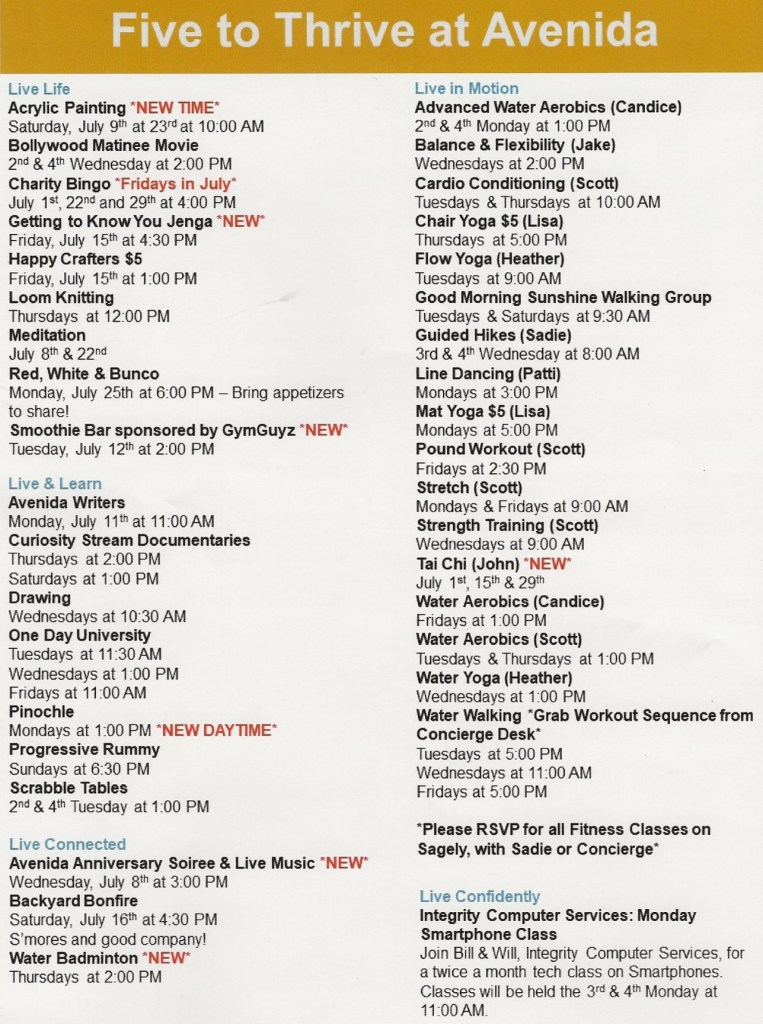
In any given month there are over 300 group activities for our 275+ fellow residents. (See below for the various groups and activities for the month of July.) I myself will attend three fitness classes this week — one on strength building, another on balance and flexibility, and a third on cardio conditioning. Rita likes her Mahjong group and a couple card game groups, and she is joining me on one of those workouts. I also joined the group that writes the monthly newsletter.
That’s just 2% of the available activities, however, and over half our fellow residents engage in 10 or more activities each month. That’s what creates the community. Rita and I are new, so we don’t know everyone’s name, but it seems that many fellow residents do, and social director Sadie definitely knows everyone by name.
Being in our 70s, it’s inevitable that one day in the next 20 or so years, one of us will pre-decease the other, and I can already see that many arms will embrace the one of us who lives on. One well-loved resident died in March (none since, by the way), and he was mourned in the newsletter — which also features a paragraph about each resident who moves in or leaves.
So, community is the number one “pro” of our new lifestyle. In our prior homes, Rita and I never experienced such a sense of community.
While one might miss the lawns and gardens of his/her single-family home, it’s hard to miss the weeding, lawn mowing and snow shoveling — although I did enjoy using my new electric snow blower! (I have it in storage, if you’d like to buy it.)
Rita wasn’t keen about our move initially but has come to love our new home. The few “cons” that we came up with, such as having to dispose of so many possessions or having to walk the dog instead of letting it out the back door, have proved in the end to be positives.
Getting rid of decades of accumulated possessions was a challenge, but a good one. Our heirs will have far less to deal with, and several charities benefited from our donations. And having to walk the dog helps me complete the exercise rings on my Apple Watch each day!
We no longer have a garage, just a carport in the parking lot. With less need of two cars, we have downsized to just one. There are four ChargePoint charging stations in the parking lot, and there’s a bike room for my electric bike.
We have no pantry and a smaller refrigerator, and there’s no place to put a second refrigerator or freezer, so we are spending less money at Costco these days. We were able to rent storage cages on the same floor as our apartment, which helps.
We had to drive to everything before, but now we are within walking distance of a King Soopers, a liquor store, and three favorite restaurants (Mexican, Chinese and Japanese) plus a light rail station.
Several food trucks come to our building each month, and a mini farmer’s market sets up in one of the many common spaces each month. A carpool to a weekly farmer’s market is one of the summer activities.
We don’t have a guest bedroom as we did in our home, but the building has two nicely furnished guest apartments that residents can reserve for a reasonable fee.
Our kitchen is much smaller than the fabulous kitchen in our home, especially regarding counterspace, but Rita bought a rolling island and recently volunteered to me that she loves our kitchen now.
Our stacked washer and dryer aren’t as nice or as big as our high-efficiency units were, but there are jumbo units in the basement that we can use for free if the need arises (for comforters, etc.). There’s also a dog wash room, but our mobile groomer comes to Avenida just as she did to our prior home. Rita and I like to patronize the salon, too!
Security is another advantage of our particular community, with a private security company patrolling our parking lot and sidewalks from dusk until dawn every day. Residents are issued a credit card-sized RFID card which opens all the doors and gates to the building.
I welcome readers’ feedback on this perspective on the 55+ rental option. It should be pointed out that there are many different types of 55+ communities including ones with owned single-family homes.
A reader sent me the following message and I checked out his website. I checked it out, and it’s quite thorough and helpful. A couple things to keep in mind when reading it: 1) There is no “standard” real estate commission, but this website quotes a 6% standard commission. I charge 5.6% at most — less if I don’t have to share it with a buyer’s agent and less if I earn a commission on purchasing a replacement home. Also, my top commission for homes over $1 million is 5% with those addition reductions mentioned above. 2) If you use Golden Real Estate, you don’t need to rent a U-Haul for local moving. We provide a free moving truck similar to a large U-Haul, and in some cases we provide free driver and movers, plus free moving boxes, etc. Call for details!
Here’s the message received from a reader of this blog with that recommended website:
My name is Joseph and I work with RetireGuide.com; a free site dedicated to providing accurate, useful information to help today’s seniors fulfill their retirement goals.
We recently published a step-by-step guide to downsizing for seniors or those working towards retirement. Here we cover everything from finances and moving logistics to coping with the emotions that come from parting with a family home. Please feel free to take a look:
In my March 10 column (read it at www.JimSmithColumns.com), I announced that Rita and I had decided to sell our Golden home and become renters for the first time in 50 or so years for both of us. A year ago, I could not have predicted such a decision so early in our youthful 70s. I thought you’d like to know how that has worked out for us, in case I got you thinking about a similar move yourself.
Our reasoning was simple. We felt that our home, which we could (and did) sell for 2½ times what we paid for it ten years ago, was unlikely to keep appreciating, and the money we would pocket from selling could more than support us for the rest of our lives. Since I’ll continue making a good income as a Realtor for several more years, we could pay all our living expenses without touching the principal, which we have since invested half in equity stocks and half in a Transamerica annuity with downside protection. (Ask me if you’d like references to our two advisors.)
Zillow and other valuation models show our former home continuing to appreciate, which is good news for our buyer, but it’s hard to predict how much longer that will be true. I feel we may be at or near the peak of the market. The experience with other listings in the past month suggests that, yes, the market is softening, triggered primarily by the rapid rise in mortgage rates.
So, are Rita and I happy in our new 2-bedroom/2-bath rental? The answer is a qualified “yes.” It definitely was an exercise in “letting go” to move from a 2,639-sq.-ft. home with its 3-car garage and its 2,281-sq.-ft. basement full of “stuff” into our 1,096-sq.-ft. apartment. I made countless trips to Goodwill, plus targeted donations elsewhere. We gave three unused bicycles plus accessories to the Golden Optimists’ Bicycle Recycle program, gave our gas generator to a Habitat for Humanity group, gave our air compressor to our handyman who uses it to blow out sprinkler systems, and, most helpful of all, included virtually all our furniture in the sale of our home.
It was, in short, quite a process of letting go, not just of miscellaneous possessions accumulated over the years, but also of family heirlooms which had been passed down over the years from our two families.
We had boxes and boxes of artifacts and papers in our basement which we spent many hours culling, recycling most of it. (I didn’t quite finish and have a few boxes in storage that I will get to “sometime.”)
Yes, we rented storage space — both a long-term unit at Public Storage and two small cages in our apartment building a short distance from our apartment for short-term storage — stuff that might otherwise go in a pantry or closet if we had a larger unit.
Long before we had decided to sell and downsize, Rita and I had purchased a week-long cruise of the Mediterranean, which began three weeks after our move into the apartment. We had barely settled in by that time, and the cruise allowed us to experience living in 200 square feet for long enough to make our 1,096-sq.-ft. apartment feel rather spacious when we returned.
As I write this, another 16 days have passed, and we are finally settled in and enjoying our new digs. We spend a lot of time on our south-facing balcony with its view of Green Mountain and the foothills. We watch less TV, having “cut the cord” and subscribed to YouTube TV. We watch much less news and more Netflix movies and programs.
We are also beginning to take advantage of the many programs at Avenida Lakewood, although the press of business is keeping me from taking the yoga and fitness classes which are offered. Shown here is a picture of the sign in our elevator listing the various facilities in the building, to give you an idea of what’s offered. A recent census reported by our community manager said that 70% of the 266 residents in Avenida’s 207 occupied apartments have participated in 9 or more activities, and that 57% of February’s programs were created and led by a resident. There were 314 programs on the March calendar. Talk about “active living”!
Continental breakfast is served daily except Sunday on the main floor and is one of many opportunities to meet fellow residents. Being on the 4th floor, we also meet people in the elevator, and everyone is super friendly. Residents don’t pass each other, indoors or on the sidewalk, without saying “hello.” This is a contrast from our single-family subdivision, where there were few opportunities to meet our neighbors. I already know more neighbors in this building than I knew in that subdivision.
Rita has made use of the full-service salon, where I have already had a haircut. Rita joined a card game and a Mahjong group, meeting additional neighbors that way. I attended the men’s group where we discussed possible events. I will be driving up Mt. Evans with some of the men after that road opens.
At this time, 95% of the apartments at Avenida Lakewood have been leased. (It was only opened in the summer of 2019.) Soon they will start creating a waiting list. Call me if you’d like to know more or be introduced to the sales staff. Don’t call me if you smoke, however. It’s not permitted anywhere in the building or on the grounds — even within your apartment or on your balcony.
In conclusion, Rita and I feel that we made the right decision. Thanks to the nest egg we created by selling our home, plus Medicare and our long-term care policies, we feel that our future is secure and we can even splurge on more vacations.
I don’t know how many communities there are like Avenida, which charges rent with no “buy-in” that would tie up capital that could otherwise be producing income. Jenn Gomer of CarePatrol told us about Avenida and we didn’t look further. I recommend calling her at 720-788-2364 if you want to know other options.
For Rita and me, we like the flexibility of our one-year lease which gives us the freedom to stay or move a year from now.
Rita and I recently decided to sell our home and move into Avenida Lakewood, a two-year-old community near Colfax and Quail which boasts “Resort Inspired Living” for people 55 or older. (Actually, a spouse can be under 55.)
We were also looking at Vita Littleton, but Avenida is closer to Golden Real Estate’s office, and I’m not retiring.
But that’s the point. You don’t have to retire for living in a 55+ community to make sense. The rent for our two-bedroom, two-bathroom apartment with 4th floor mountain views is competitive with a comparable apartment with none of Avenida’s many amenities and activities which drew us to sign a one-year lease. And there’s no 6-figure buy-in or “entry fee” as there is with many 55+ communities.
Jenn Gomer of CarePatrol specializes in helping seniors like us find the community which best fits our needs, and she recommended Avenida to us. (We hadn’t heard of it.) If you’re in our demographic, I suggest you call her office at 720-675-8308 and discuss what might be best for you. Such communities vary greatly, with some, unlike Avenida, providing “continuity of care,” meaning that you don’t have to move if your health deteriorates and you require assisted living, nursing home or hospice care.
Are you thinking that now’s the time to leave your big-house life behind? If so, you’re in luck. Despite the pandemic, the real estate market is strong, interest rates are low, and it’s still a great time to sell and buy. But you can’t go into the process blindly. Here are some tips to get you started on the right track.
First on your to-do list: Work with an experienced agent like those of us at Golden Real Estate. After all, an agent who knows the area can price your home correctly and help you find the right replacement home for you. We know the local market and whether a neighborhood is senior-friendly. You can ask us questions and get knowledgeable answers about local amenities, such as public transportation, fitness centers, and local senior facilities that will enrich your life.
If you prefer to downsize into a rental unit within a senior community, we can advise you on those communities and that process too, so feel free to ask us.
We can also help you determine a budget. As a buyer, keep in mind that it’s a seller’s market, and having us on your side can help get your foot in the door. If you’re moving locally, we can also save you a bundle with our free moving truck and our in-house movers.
You want to take a look at your budget to determine what you can afford. Our preferred lenders offer free affordability calculators. They allow you to input data, such as your home price, down payment, and monthly expenses. This can help you determine your potential future living expenses.
Once you have an agent and a price range, it’s time to compare what you can afford with what you need, and then make adjustments to your list as necessary. Many seniors, according to Home Tips For Women, look for features including those which lower utility costs. These, along with things like single-level living and wide doorways, allow for greater mobility, an important consideration if you’ve already begun to experience mobility issues.
Something to keep in mind during the downsizing process is that moving into a smaller home will require downsizing your belongings as well. Once you have chosen your future home, you can evaluate the belongings in your current one. This is an emotional process which takes patience, and, ideally, you’ll have cooperation from your friends and family. It’s often best to give certain things to your children and grandchildren now so you’re not tight on space in your new home. You can use our truck for that, too (and for trips to Goodwill).
If you’re moving outside the metro area, choosing the right moving company is something else that deserves special attention. Movers charge different prices, even for what appear to be the same services. Your moving company will factor everything from whether you need an entire truck to how far you’re moving, to the overall weight of your household goods into the price. Previous clients have given us feedback on their experiences which we can share with you.
Finally, make your move while you’re in good health and don’t wait until you have to move. And let yourself enjoy the process. Your retirement is a time of change and to feel all the excitement associated with it. Moving is not always easy, but the end result of downsizing can be more financial freedom and a better quality of life during your senior years.
Downsizing as a senior presents a significant lifestyle change, but it’s one to embrace. If you still have questions, don’t be afraid to reach out to us. My broker associates and I (see below) are here to make the process as seamless as possible and can be a valuable resource not to be overlooked.
Colorado doesn’t rank high in the percentage of our population that’s 65 and over. In fact, seniors represent only 14.2% of our population, ranking Colorado 46th among the 50 states.










 Jim Smith's Blog