Jim Smith is best known for his weekly "Real Estate Today" column published on the Real Estate page of The Denver every Saturday and in 24 metro area weekly newspapers the following Wednesday or Thursday. Individual articles are also published at http://RealEstateToday.substack.com. Over a decade of the columns are archived at www.JimSmithColumns.com.
Many buyers and sellers of real estate are wondering whether we’ll see the kind of crash in real estate values that we saw in the Great Recession of 2008 onward. Experts agree that we will not.
In an April 22nd post, realtor.com explained that circumstances this time are quite different from then. Reasons cited by realtor.com’s economist, Danielle Hale, include the following:
First, the 2008 crash was created by a rash of bad mortgages — a situation that was remedied because of that crash. Second, there was an oversupply of houses for sale, whereas today there is an undersupply.
According to the realtor.com post, “There are simply too many would-be buyers out there: millennials eager to put down roots and start families, folks who lost their homes during the last recession and want to buy another property, and boomers looking to downsize.”
Lawrence Yun, chief economist at the National Association of Realtors, predicts that home sales will pick up again quickly and that prices will not fall. He sees the luxury market taking the biggest hit, largely because the buyers of those homes may have lots of financial liquidity, but it is in stocks which they don’t want to sell while prices are low.
Also, widespread mortgage forbearance will prevent the surge in foreclosures we saw before.
The term “virtual tour” was introduced to the real estate industry a couple decades ago, but only because photography vendors were able to convince listing agents to hire them and competed to offer the coolest technology.
Early vendors wowed us with 360-degree still photos of each room, although that is now out of style.
The latest “shiny object” is a 5- or 6-year-old product by Matterport. I remember getting a demo of it at a trade show in San Francisco. They call their product an interactive virtual reality (VR) tour of still photos in which you can use your mouse or finger to rotate each photo manually left to right or up and down. Gray circles indicate new photo points. You click or touch them and you are taken to that place where you can, again, rotate horizontally or vertically. Thus, you can, at your own pace, navigate around the entire listing choosing which room you want to enter and leave.
The “coolest” feature of Matterport is the “dollhouse” view, shown here. You remember dollhouses, where one side was open so you could look inside each room? That’s what Matterport’s dollhouse view is like except that it’s on your screen and you can rotate it on any axis.
Still, it’s only a collection of still photos with no narration. Personally I find it kind of dizzying and nowhere near as useful as being walked through the home by a listing agent with a video camera who explains the obvious and not-so-obvious features of the home. I wouldn’t call anything less a “virtual” tour.
I have been selling real estate now for 18 years and seen maybe a dozen different variations of the “virtual tour” concept, but almost all of them are nothing more than still photos presented in different, often interactive ways. None have the advantage of a simple video walk-through of a home by the listing agent. That’s what we do at Golden Real Estate, and have been doing since 2007. Click on any of our listings at www.GRElistings.com to see what a good narrated video tour looks like.
What amazes me is how few agents do what we do. In the article below, I mention that 114 homes listed last week went under contract by week’s end, at a time when in-person showings and open houses were not allowed. Assuming they followed the 2-week-old rule against in-person showings, buyers of those listings had only the photos and “virtual tours” on the MLS to go by in making their decision to submit an offer.
One might assume that those 109 listings had great virtual tours, but almost none of them did. Surprisingly, only 65 of the 114 had any “virtual tour” on the MLS, but more surprisingly only two of them had a narrated video tour. Five of them had video walk-throughs with music. One had no sound track at all, and one really cracked me up. The agent held his smartphone horizontally, but his footsteps and breathing were all you could hear. Imagine if an agent walked you through his listing in person and never said a word about anything — that’s what it was like!
The two narrated tours were quite good in the detail which the agents shared, but they both shot with their phones in vertical mode and one was quite shaky since it was handheld. Too bad she wasn’t using the Osmo camera that we use, which has a gimbal, making the picture totally steady.
About half of th0se 65 listings with virtual tours had Matterport tours, which I found very disappointing. Others were just slide-shows with music, and many were just a collection of still photos or brochures.
Each week I have been checking the MLS to see how many homes are being listed afresh and how many are going under contract as the Covid-19 stay-at-home order remains in place.
In last week’s column I reported that during the 7-day period from Sunday April 5th to Saturday April 11th, a total of 819 homes within 25 miles of downtown Denver were entered on Denver’s MLS, This past week — from Sunday April 12th to Saturday April 18th — that number dropped slightly to 799. Of those, 23 had already been sold privately, compared to 22 the previous week, so there were only 776 new active listings last week. Amazingly, 114of those went under contract by Saturday, compared to 124 the previous week, despite stricter enforcement of the “no-showings” guidance from the Division of Real Estate. Another 74 of those new listings went under contract by Tuesday evening, April 21st.
Bottom line? The roughly 50% drop in listings from previous years which we saw last week has become the “new normal” for the current situation in which in-person showings are not allowed until a buyer has signed a contract to buy a home.
This is actually a great time to list your home! The fact that so many buyers are still submitting offers without even seeing a home in person should inspire more sellers to offer their homes for sale. Just be sure you do it with a narratedvideo tour like we do for all Golden Real Estate listings.
Whether you’re moving because of a job, family expansion or retirement, you’ll have to roll up your sleeves and get to work if you want your property to appeal to the most buyers. Before you start packing, however, there are a few minor home improvements you should tackle, which will speed up the process and get you on the road.
Start with aesthetics
No matter how short a time you’ve lived in your home, there are likely lots of little things that you’ve learned to overlook. The vast majority of these will be minor aesthetic imperfections that are cheap and easy to rectify. ProfessionalStaging.com notes that buyers are on the lookout for issues andwill notice every little crack, stain, or chipped tile. Here are a few DIY projects that will reduce the lived-in look of your home:
Replace moldy or damaged caulk in the bathtub and shower
Clean or stain grout in the kitchen and bathroom
Fill nail holes in the wall and gaps around the trim
Plant colorful flowers by the mailbox and entryway
Organize storage spaces (buyers love to look in closets, under the stairs, and in the garage and attic)
Paint rooms that don’t already have a neutral color scheme
Install functional smoke and carbon monoxide alarms
Pull weeds and add a layer of fresh mulch to flower beds
Replace outdated bronze and brass doorknobs, handles, and drawer pulls
Manage major malfunctions
There are plenty of small things you can tackle on your own, but you’ll also need to invest time and money making sure there are no major defects that may derail your home sale at inspection time. These include:
Foundation problems (Homes.com estimates this candevalue your property by up to $100,000)
HVAC issues
Mold
Leaks in the roof/missing shingles
Major plumbing problems, such as a clogged mainline
Outdated electrical panel
Windows that won’t open up or lock
Musty/animal smell
Rotted wood behind walls – most likely in the kitchen or bath
Damp basement
Small issues won’t necessarily be deal-breaker for most of your buyers but the less work they have to do the more likely they will be to give your home a second look. Large issues such as a crumbling foundation may designate your home as a fixer-upper, which won’t attract “everyday” buyers who want to move in immediately.
What do buyers want?
Buyers in different demographics will seek out home features that appeal to their lifestyles. There are, however, a few universal want-list items you can play up in your listing to cast as wide a net as possible. According to American Home Shield, thefeatures homebuyers want are:
Once you’ve completed these repairs and renovations, there are a few finishing touches that will put the icing on the cake and sweeten the deal for your buyers. First, you should declutter, so that buyers can see more of the house and less of what you own. Before you declutter, though, it’s a good idea to buy an air filter. Since digging through those items is going to stir up a lot of dust, it’s important to keep the air clean for you and home buyers. [Note: Golden Real Estate provides its sellers with a free staging consultation.]
After you declutter, deep clean the entire home and weed out any belongings or furniture that don’t look quite right. To get your home sparkling clean, spend a little money on a housekeeping service. For an average of $166 a visit in Golden, housekeepers can help you keep up with laundry, mopping, sweeping, vacuuming, and straightening. Just keep in mind that the more you request from the housekeeping service, the more you’ll ultimately pay for the privilege.
Also, staging and investing in high-quality professional listing photos (a real estate photographer usually charges between $110 and $300 for a shoot, depending on your location) will give online searchers a reason to pay your house a visit. [Note: Golden Real Estate pays for professional photography and shoots a narrated video tour for all its listings. See examples at www.GRElistings.com.]
Perhaps most importantly, you’ll need to choose the best listing agent. Interview multiple individuals and ask about their recent local sales history and how many current listings they manage. A good agent will encourage you to price your home competitively and will go above and beyond simply listing on the MLS to promote the property. [Call 303-525-1851 for a free market analysis by broker/owner Jim Smith.]
Each week I have been checking the MLS to see how many homes are being listed and how many are going under contract as the Covid-19 stay-at-home order remains in place.
For the weeks of March 22nd and March 29th, the market showed surprising resilience, with statistics comparable to prior years. Now let’s look at the statistics for last week.
During the 7-day period from Sunday April 5th to Saturday April 11th, a total of 819 homes were entered on Denver’s MLS, REcolorado, within 25 miles of downtown Denver. Of those, 22 had already been sold privately, so there were only 797 new active listings. Of those, 133 were already under contract by Saturday. A total of 25 were immediately withdrawn or expired, many of them likely because of the no-showings rule, which was issued that Monday.
This is a huge drop from the same 7-day period in 2019, when there were 1,631new active listings, 227 of which had gone under contract by the end of the same 7-day period.
In 2018, the numbers were similar, with 1,588new active listings, 579 of which went under contract within the same 7-day period.
In 2017, the numbers were also similar, with 1,633new active listings, 663of which were under contract by the end of the same 7-day period.
The numbers were equally impressive in 2016.
Bottom line? We are finally seeing about a 50% decline in new listings, but many of them are still selling quickly. Sellers who do list their homes may benefit from the lack of competition.
…that is, if the listing agent does what Golden Real Estate has done for over 13 years — create a narrated walk-through video of each listing.
Our narrated video tours are just like a showing. They are live action videos which start in front of the house (just like a real showing) and then go through the house and into the back yard, pointing out features as we go.
Check out the video tours for any of our current listings at www.GRElistings.com to see what I mean. They really are like an in-person showing with the listing agent. For example, the video camera points down to the floor and up to the ceiling as I describe the hardwood floor or the sun tunnels which bring natural light into the home’s interior.
But, you say, you’re not going to buy a home that you can’t see in person. Right? You don’t have to, because the rules allow for inspection once the buyer has signed a purchase contract. Your visit (presumably with an agent) the very next day constitutes an inspection. That can be before you even have to deliver your earnest money check, since you may not even be under contract yet. The guidance from the Division of Real Estate says, “home inspections and final walkthroughs after a buyer has signed a purchase contract (emphasis added)… is also considered to be an essential part of the real estate transaction.” The buyer is not under contract simply by signing a contract that has not also been signed or countered by the seller.
That “guidance” from the Division of Real Estate was issued on April 9th and has not been updated as of April 18th, which is when I am updating this blog post.
Scott Peterson’s April 15, 2020 “Legal Bite”
However, Scott Peterson, general counsel for the Colorado Association of Realtors, maintains in a video recorded from quarantine on April 15th that the governor’s executive order prohibits any “marketing” that involves entry into a property – no photos, no video, nothing at all – without a contract in place. If that’s true, however, why isn’t it reflected in the April 9th guidance and why hasn’t that guidance been updated?
I tried Googling the governor’s executive orders and looked at his web page on www.colorado.gov/governor and saw only two executive orders on other matters and no link for all his executive orders. So, for now, I lack evidence of Scott Peterson’s claim and am relying on the April 9th guidance, which I keep checking for updates.
Therefore, a visit to the home by a buyer immediately after signing an offer to purchase the home does, in my opinion as a broker, comply with guidance currently in effect from the Division of Real Estate. Then, if the buyer is able to get under contract with the seller, he or she can schedule a second inspection by a professional inspector.
So, here’s a possible scenario: You look at the video tour of the patio home or the ranch-style luxury which you found at www.GRElistings.com. I guarantee you’ll have a pretty good sense of the home from viewing that video. You’ll experience the flow from kitchen to dining room, to family room, to back yard, etc., because you are being walked through the home. It is not a slideshow of different rooms, giving no indication of flow from one room to the next.
Let’s say you call me or your agent to submit a contract and let’s say that it is accepted by the seller. You’re under contract! The typical contract has a 7- to 10-day inspection period. You schedule your personal inspection with your agent (or me, if you don’t have one) the next day, before delivering your earnest money check, which is typically due in 3 days. You can terminate immediately if you have buyer’s remorse, and go back to looking at other houses.
If you don’t terminate, you still have a week to hire a professional inspector and submit a detailed inspection objection.
What if you’re a buyer, and there’s no such video for a house that interests you, but you don’t want to sign a purchase contract? I believe you’ve got three choices here. One, your agent (me, for example) could ask the listing agent to create and provide a narrated walk-through video. Second, I could preview the home for you since the guidance make no mention of banning previews, and shoot my own rough-cut video tour of the home, post it as an “unlisted” video on YouTube and send you the link. Or, third and perhaps best, we could use Facetime, Zoom, or another app to have you see what I’m seeing as I walk you through the house. (NOTE: Scott Peterson believes that previews and videos shot by anyone other than the seller are not allowed. I just don’t have any documentation supporting that position.)
Therefore, while it may be inconvenient not to have an in-person showing of a listed home, there are work-arounds that can make it possible to get under contract and confirm your interest in the property before you are fully committed to it or put down any earnest money.
Finally, I’d like to note that many listings are empty and vacant. I see no reason why in-person showings of those listings should not be allowed. I know that builders are letting buyers view their empty homes. Again, Scott Peterson maintains that empty homes cannot be visited either. Show us the actual orders from the Governor or guidance from the Division of Real Estate, Scott!
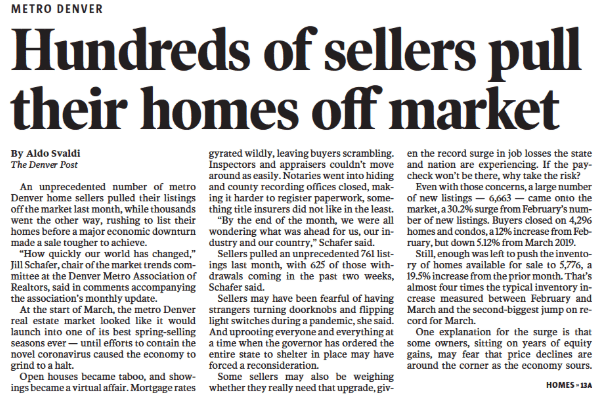
“Hundreds of sellers pull their homes off market,” read the lead headline on the Business page of last Friday’s Denver Post, but the first sentence of the article noted that “thousands [of sellers] went the other way, rushing to list their homes before a major downturn made a sale tougher to achieve.”
The reporter was referring to March statistics quoted by the chair of the market trends committee of the Denver Metro Association of Realtors.
Let’s look at the actual numbers. Yes, 184 listings that were entered during the month of March were “expired” on the MLS by month’s end. Another 443 listings were “withdrawn,” which means the listing agreement is still in effect, but it is not displayed on the MLS until it is made “active” again.
However, 3,525 listings entered last month are already under contract as I write this on April 5th, and another 467 listings have already closed. Of the ones that closed, 179 were sold before being entered on the MLS, and of the 308 that were exposed to MLS users as active and had already closed by this past weekend, only 13 took longer than a week to go under contract.
As I write this on April 5th, there are still 4,289 listings that were entered on the MLS during March and are still active.
So, yes, 184 sellers decided not to sell during March, but 8,122sellers made their homes active on REcolorado during March and did not withdraw or expire them. Another 443 sellers kept their listing agreement active but without exposure on the MLS. Presumably their listing agents can still sell those listings privately, perhaps keeping their entire commission instead of having to share it with a buyer’s agent.
So the headline was sort of accurate.
By the way, unless the practice has changed since I was a reporter at the Washington Post and then a headline writer at the New York Post, reporters have no say in the headlines that appear above their articles. Instead, a headline writer on the “copy desk” reads the article briefly and writes a headline that fits the assigned character count. As a result, sometimes the headline doesn’t truly reflect the gist of the article, and that may be the case with last Friday’s article.
From the New York Post, I went on to publish several community newspapers in New York City and instructed my reporters to write their own headlines, not knowing what the character count had to be, so the editor had the reporter’s headline as a guide as he rewrote it to fit.
Getting back to real estate — sorry, I had to vent! — here are the numbers from March 2019:
A total of 7,968listings were entered as “active” during March 2019, which is fewerthan this year, even if you include the 70 listings that were withdrawn by month’s end. So, not only was the headline misleading, but this March showed increasedactivity over March 2019.
The fact that 70 listings were expired prematurely in a “normal” month suggests that not all 184 expired listings this year should be attributed to Covid-19.
The market was “hotter” last year, in that over 400 of that month’s listings went under contract in less than 7 days compared to just under 300 this March.
I invite any and all reporters writing about real estate statistics to let me fact check their conclusions prior to publication. And suggest your own headlines!
Business coaches exist in every industry, and I’ve dabbled in hiring a coach over the years.
When I first entered the business, I had a mustache, and Mike Ferry, the best known of all real estate coaches, said to shave it off because “people don’t trust agents with facial hair.” A week later I asked a seller why he listed with someone else, and he said, “Well, I didn’t trust you.” Off it came!
Recently I was offered a free one-hour coaching session with a lesser-known coach, and I accepted the offer.
During the session, he thought I was giving my services away too cheap. He said I should charge 7% and not reduce my commission when I don’t have to share it with a buyer’s agent. (I charge 5.6% and reduce it to 4.6% if I double-end a transaction.)
He didn’t like that I further reduce my commission when I earn a commission on the purchase of a seller’s replacement home and that I provide totally free moving in that situation, too.
“You’re worth more than that,” he said. I didn’t hire him as my coach.
The Denver real estate market, based on my own analysis of REcolorado listings, showed continued strength last week, despite the imposition of a statewide stay-at-home order by Gov. Jared Polis that Tuesday.
To my surprise, despite the growing COVID-19 threat with all its expected economic impacts, a total of 1,799 listings went “active” on REcolorado last week — that is, between Sunday the 22nd and Saturday the 28th.
Although 53 of those new listings were taken off the market the same week — likely because of the stay-at-home order — and 24 of them were entered as “sold” without ever being active, that left 1,722 new listings on the market, and 387 or 22.5% of them were under contract by week’s end. That does not sound to me like a real estate market that is stalling because of the COVID-19 virus.
It makes me wonder about those 53 listings that were pulled off the MLS because of the stay-at-home order. How many of them would have been under contract by now had the sellers and their listing agents not been overly cautious?
The homes that went under contract within their first week on the MLS ranged from a 2-bedroom, 1-bath condo for $100,000 in the Windsor Gardens senior community south of Lowry to a 4-bedroom, 4-bath home for $1.3 million in the foothills northwest of Boulder. The median price of those homes was $425,000.
To see how last week compared to “normal,” I researched the listings that were first entered on REcolorado during the same seven days in 2019.
Surprisingly, slightly fewer homes were entered on Denver’s MLS during the same 7 days a year ago — 1,727. Of those, only 12 were taken off the MLS that same week. Another 73 were entered as “sold” that week. Of the remaining 1,642 listings, 670 or 40.8% went under contract within a week. That’s much higher than the 22.5% this year, but consistent with the slowing of the market which we saw before the advent of the virus. Those 670 listings which went under contract within 7 days last year ranged from a $95,000 condo in Aurora to a $1.5 million dollar 6-bedroom home in South Boulder. The median listing price was $395,000.
As you might guess, I was concerned about whether the new Lakewood ranch listed by me last Wednesday would get any showings, since showings didn’t begin until Friday, three days after Gov. Polis instituted the stay-at-home order. I needn’t have worried. We had five showings by Sunday, with one agent calling to ask if we had any offers yet because his buyer was interested in submitting an offer.
Also on Sunday, a buyer I hadn’t heard from in months called about seeing a new listing. I set a showing for that afternoon, and the buyer is considering making an offer.
All in all, then, this market continues to surprise me. While it is slower in terms of activity, there are still many serious buyers willing and able to make offers on new listings. Those buyers who are unable or afraid to make an offer, whether for economic or health reasons, are not calling us. Agents might appreciate the fact that only serious and qualified buyers are going to call about seeing homes for sale.
Meanwhile, sellers who want to sell should recognize that there are serious and qualified buyers out there and consider putting their home on the market. Just make sure you use an agent like us at Golden Real Estate who does narrated video tours of listings.
The practice of real estate has come a long way from the days when homes were only listed in books the size of a big-city telephone directory. (You do remember telephone directories, don’t you?)
Back then life was simpler, but that depends on how you define “simpler.” Purchase contracts were one or two pages instead of 20 pages, and they had to be hand delivered, as did subsequent documents such as inspection and appraisal objections. Mortgage applications and information was all faxed, if not delivered in person.
Actually, life is simpler today. All documents are typically emailed back and forth and signed electronically, except for closing (which has to be done in front of a Notary).
As you know, homes for sale can now be searched and viewed online. An in-person showing or two is common before submitting an offer, but not always necessary. Because our narrated video tours are just like an in-person showing, led by the listing agent, I’ve had out-of-state or even foreign buyers ask me to create a purchase contract, knowing that they can always terminate (which they haven’t) when they fly in for the home inspection. Here’s an example of one of our current video tours:
Example of a Golden Real Estate narrated video tour – 1957 S. Taft St. – Listed last week
Facetime is also a great tool for showing homes. When one of our own buyers from out of state expresses interest in a home which they learned about from an MLS email alert — another new technology tool — our agent will use Facetime or take our video camera and do a narrated walk through of that listing (because the listing agent did not create such a tour), and post it on YouTube as a private or unlisted video, and send a link for it to the buyer.
Zoom came along just in time for COVID-19, replacing GoToMeeting as the “go to” software for virtual meetings. A classmate from long ago sent me a link for a virtual 6-person band performance of an adaptation of the Bee Gees’ “Stayin’ Alive” cut, with COVID-19 lyrics. What a hoot!
Even this column is made possible by technology that wasn’t available when I was a newspaper publisher. I create it on my laptop using MS Publisher, create a PDF of it, and send it to the newspaper on deadline, which is two days before you see it in print. Then I post it on this blog, which has hundreds of subscribers, and email it to 900 people who have chosen to receive it by email because they no longer subscribe to a printed newspaper.
Of course, this newspaper, like most, is also available in a “digital replica edition” on its website, which reaches even more readers. I love technology and how it has made life simpler!