
As Earth Day Approaches, Coloradans Have Many Opportunities to Do Their Part

Real_Estate_Today_bylineThis Sunday, April 22nd, is the 48th anniversary of Earth Day. Here are some of the ways you can participate in this annual event and do your part in preserving this planet for future generations.

On Saturday, April 21st, from 11 am to 4 pm, Lakewood will hold its Earth Day Celebration at the Lakewood Heritage Center, south of Belmar on the west side of Wadsworth. A no-charge bicycle valet will be on hand so your bike will be secure while you listen to live music (three different bands will play), do yoga, attend a compost workshop, learn how to create a sustainable backyard, or visit the electric vehicle expo, where a Nissan Leaf, Chevy Volt and my own Tesla Model X will be on display.  I, along with other EV owners, will be there to answer questions and demonstrate each car’s features.  See a full list of Lakewood’s Earth Day activities (far more than other cities, I’ve found) at www.Lakewood.org/earthday.

Recycling is a popular Earth Day activity, particularly the recycling of electronic waste. Adjacent to their Earth Day event, at 777 S. Yarrow Street, Lakewood is accepting e-waste, but for a fee.  Meanwhile, the Denver Metro Association of Realtors will accept e-waste free of charge at its Jeffco office, located at 950 Wadsworth Blvd. from 8am to noon that same morning. You can drop off unused, unwanted and nonfunctional electronics. This is a great way to responsibly recycle nearly anything with a plug or battery!  Recycling is open to the public and is free, with the exception of televisions and monitors, which carry a fee of $20 to $60 depending on size. There’s also a $5 charge if you ask to have hard drive data destroyed.

Residents of the City of Golden can recycle e-waste and many other items during its “Community Pride Days,” which is the weekend of May 19-20.  The city doesn’t charge for this service, although proof of city residency is required. A Golden mailing address does not by itself make you a City of Golden resident.

Year-round you can bring block white Styrofoam to Golden Real Estate’s “Styrofoam Corral” behind our office at 17695 S. Golden Road.  At least once a month, the 10’x20’ corral fills up and we truck it all to one of three recycling/reprocessing facilities, but ours is the only location in Jefferson County for dropping off this material.  We estimate that we keep over 200 cubic yards of polystyrene (the generic name for Styrofoam) out of the landfills every year.

Other recycling:

  • You can bring up to 5 gallons of used paint to many Ace Hardware, Guiry’s and Sherwin Williams stores. See www.paintcare.org for locations.
  • Donate your unwanted bicycles to the Golden Optimists any Tuesday or Thursday from 1 to 5 pm, at 1200 Johnson Road (next to the Golden main post office).
  • Take old clothes hangers to any dry cleaning store.
  • Home Depot accepts unbroken CFL light bulbs for recycling.
  • Any Staples or Office Depot store will accept used toner or ink cartridges and give you a credit if you are a rewards member.
  • King Soopers and Safeway accept plastic shopping bags for recycling.
  • O’Reilly’s accepts used motor oil.

Would You Like to Be Alerted to Real Estate Activity in Your Area?

Would you like to know when homes in your subdivision go on the market, go under contract or are sold?

As a free service to our readers, we can set you up to receive an email alert within 15 minutes of any of those real estate events occurring in your neighborhood.

To get it started, all you need to do is send an email to info@GoldenRealEstate.com,. Provide your own address and the outlines of your neighborhood or the name of your subdivision, and we’ll get you set up.


Buyers Save a Little on Property Tax When Buying a Long-Held Home from Seniors

Real_Estate_Today_bylineAs homeowners 65 and over well know, they get a discount on their home’s property taxes once they have lived in their home for at least 10 years.  It’s called the “senior property tax exemption.”  For those who qualify, 50% of the first $200,000 in actual value of their primary residence is exempted from property taxation.  At 100 mills, that’s worth $720. Rita and I have been in our current house for six years, so we can look forward to saving about that much on our property taxes if we stay put for another 4 years – and if the state legislature continues to fund it, as I’ll explain below.

A veteran who has been deemed permanently disabled by the VA enjoys that same discount, but isn’t subject to that 10-year rule. He/she only has to have owned and lived in the house on Jan. 1st of the tax year. There is also a little-known program by which qualified seniors and veterans can defer the payment of property taxes. Under that program, the state of Colorado pays your local property taxes, creating a lien against your home for the deferred amount, which is paid off like any lien when the house is eventually sold.  Conditions apply, of course, which you can read by Googling “Colorado senior property tax exemption,” as I did.

What you may not know is that any buyer, irrespective of age, enjoys that same property tax exemption for their first calendar year in a home they purchase from a senior citizen who earned that discount.

My new listing (below) brought this topic to mind. The sellers, who are over 65, paid only $1,221 in property tax last year, and the property tax bill will probably be the same for this year’s property taxes, which are payable in April 2019. Whoever buys the home in the next month or so will enjoy that senior property tax exemption next April and won’t begin paying the full property tax amount until 2020. The reason for this mini-windfall is that state law specifies that the exemption only requires that an eligible senior owned and lived in the house on Jan. 1st of the tax year.

Something else you may not know is that this property tax exemption does not cost the county or other local tax jurisdictions a penny. The state reimburses the jurisdictions for the discount given to qualified seniors. After making their annual revenue and expense estimates, the state legislature determines how much of a discount qualified seniors will earn. It wasn’t funded in 2009, 2010 and 2011, but it was restored in 2012 and remains in effect. Because the state’s balance sheet is expected to look good for the coming year, there’s certainly reason for optimism.

My only complaint with the senior property tax exemption is that it requires 10 years’ ownership of a home before seniors quality. This poses a disincentive to downsizing, which often makes sense for seniors, especially after one of them has died.


What If Sellers and Their Agents Don’t Disclose Known Defects to Their Listings?

Real_Estate_Today_bylineLast week I got a call from a reader who sold a house with structural defects last year, defects he had properly disclosed. He was concerned because he thought the current seller might not be disclosing those same defects to prospective buyers.  He feared that the seller had simply covered up the defects when he finished the basement, hiding them from unsuspecting buyers.


What safeguards are in place to protect buyers from being sold a home with undisclosed defects?  The primary safeguard, of course, is basic honesty — that most sellers and agents are forthcoming, as I’ve found, when it comes to disclosing defects. Another is that the listing agent could lose his real estate license if it can be proven that he or she conspired in failing to disclose a major defect.  Unfortunately, should you purchase a property directly from a seller who is not himself a licensed agent, you don’t have that same protection.

A buyer’s recourse against an unlicensed seller for failing to disclose a defect is civil in nature. The buyer would have to sue the seller and rely on a judge or jury to decide in his favor and rule that the seller must provide compensation for their deceit.  Even if successful, though, the buyer still has to deal with the defect, which can be a hassle.  And what if they’re not successful?   Well, along with having to fund the repair of the defect themselves, they’re out whatever time and money it took to work their way through the court system.  On the other hand, it costs virtually nothing for that buyer to seek damages from a licensed agent: just go to the Colorado Real Estate Division’s website and fill out an online complaint.

My personal experience is that both sellers and their agents have been forthcoming in disclosing known property defects using the very detailed Sellers Property Disclosure form provided by the Colorado Real Estate Commission.

This January, a simplified version of the disclosure was issued, and some agents, including myself, are not entirely pleased with it.

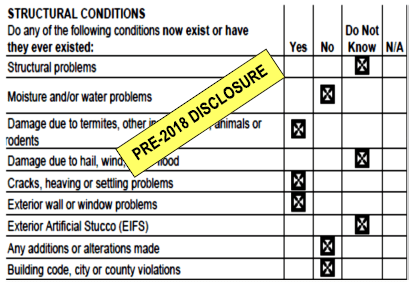
Old_SPD_formPrior to January 1st, the Sellers Property Disclosure asked sellers to answer “Yes,” “No,” “Do Not Know” or “N/A” to each item, as shown on the disclosure at right from one of my own transactions.
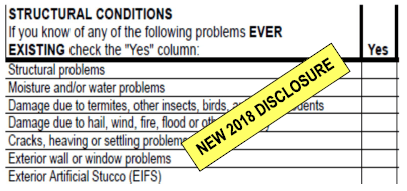
The Sellers Property Disclosure that all listing agents were required to begin using on January 1, 2018 asks only whether there is (or was) a problem, but doesn’t provide an opportunity for the seller to affirm that there is no problem.  Below is the same section of the new disclosure as completed by the seller of one of my 2018 listings.

New_SPD_formWhat was nice about the previous version was that it required an answer to every item, even if that answer was “do not know” or “not applicable.” I’m not a lawyer, but it seems to me that if there were to be a civil trial over a failure to disclose a known defect, it would be more convincing to show that the seller answered incorrectly rather than simply remained silent on the issue at hand.
One reason agents are unhappy with the new form is that there will often be entire pages of the form with no checkmarks at all, raising the question of whether the seller even completed the form.

Despite this development, you can be comfortable with the fact that listing agents and their clients take seriously their responsibility of disclosing all material facts about a property. The next time someone compares real estate agents to used car salesmen, you can tell them it’s a bogus comparison. Failure to disclose a used car’s defects isn’t a crime.


Homeowners Are Selling Homes in Record Numbers

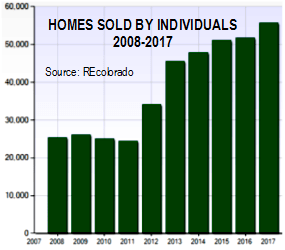
MLS_Sales_by_individuals_last_10_years    Conventional wisdom suggests that the low inventory of homes for sale is due to homeowners not putting their homes on the market. For months I’ve been pointing out that this is not true, and the chart at right proves my point. In creating it, I excluded all sales by builders, banks, corporations trusts, and government—all sellers except individuals. To the extent that an increasing number of individuals have their homes in the name of a trust or corporation, the numbers are understated.

Homes are being put on the market in record numbers. The only reason that active inventory is low is that homes are going under contract more quickly than ever. Median time on market was 64 days in 2008, 11 days in 2014, and only 8 days in 2017. That’s why acting quickly on new listings and knowing how to compete successfully in a bidding war is so important, as discussed in today’s other posting.


How Can Buyers Win a Bidding War? Here’s What Our Agents Do

Real_Estate_Today_byline     Going on three years now, the current seller’s market has allowed agents to hone their bidding war skills – something the agents at Golden Real Estate have come to do quite well. In this week’s column, I’ll share some of ways we find success for buyers in this challenging market.

Of course, agents from other brokerages use many of the techniques I’ll describe here, and occasionally we learn from them, as they do from us. In our weekly sales meeting at Golden Real Estate, we share what works and doesn’t work, cognizant of the fact that what is effective in one situation might be ineffective in another.

The more contingencies buyers waive, the stronger their offer will be. The first and biggest contingency is the sale of an existing home. A buyer may want to sell his current home in order to purchase the replacement home, but if he can demonstrate he doesn’t need to do so, his offer can omit this contingency. If the contract includes a loan, his lender can provide a letter indicating he is qualified or pre-approved for a loan without selling his current home. Even better is when a buyer can show liquid assets that can be sold in order to pay cash at closing. If he goes under contract with, say, a 45-day close, and allows us to price his current home correctly, it’s entirely possible that we can negotiate an earlier closing on his current home than on the new home.  Under such a scenario, although the assets are in place to complete the purchase without selling his current home, the buyer is able complete the transaction without having to deploy those assets or close on a new loan. We have accomplished this for many buyers.

    For example, I had a buyer who was already under contract for a new home in Arvada.  I listed his existing home for $275,000, got competing offers and was able to negotiate a sale at $315,000 with a closing the day before the seller’s closing on his new home.  He had arranged a bridge loan to buy the new home, but was able to cancel that loan and pay cash for the new home.  That’s just one of many such successes we’ve had. 

Waiving inspection and appraisal contingencies are common practices when competing with other buyers, but my preference is to leave those deadlines in the contract and include additional provisions that 1) the buyer will use the inspection deadline only to terminate, not to demand any repairs, and 2) the buyer will not demand a price reduction if the home doesn’t appraise for at least the contract price. Note, however, that if you inform the listing agent you are going to terminate because, say, the furnace needs replacing, the seller is likely to make that repair, knowing that they’d have to disclose that condition to the next buyer and they don’t want to start over. A similar scenario can often work if there’s a major appraisal problem. Perhaps the seller will compromise with a minor price adjustment, if not lower the price to the appraised value.

“Love letters” written by the buyer to the seller can pose Fair Housing problems but are still a common practice — and they can be effective.  Just this week I saw my first one in the form of a video clip showing the cute couple standing next to their wedding picture on the wall. (The seller accepted their offer over several others.)  In composing the buyer’s message, it helps if you know something about the seller. I recently submitted a buyer’s offer that was $20,000 below the listing price, despite being told there were two other offers.  We didn’t submit a “love letter” but I did say in the cover message that my elderly buyers loved the home because they’d be close to their daughter who lives in that subdivision. To my surprise, the listing agent said that if we could raise our offer by $10,000, the seller would accept it over other offers they received.

At Golden Real Estate, we do have one “ace up our sleeve” when the sellers still live in their home and are moving locally.  We offer free moving for the seller using our own trucks, moving boxes, packing materials, and even, on occasion, the labor. This has won the bidding war for our buyers more than once!

Follow-up On Last Week’s Column About Off-Market Real Estate Sales

In last week’s column, I demonstrated statistically that when sellers allow their listing agent to sell their home without putting it on the MLS, they could lose 2% or more on the sales price of their home. A reader pointed out that I ignored one way in which sellers can save even bigger — by not employing a listing agent at all.

That reader’s email betrayed two misunderstandings that lead many sellers to try for-sale-by-owner (FSBO).  First, that the typical listing commission is 6 or 7%, when it really averages about 5.5% according to the National Association of Realtors; Second, that a FSBO seller can sell their home for as much as they could if they employed a listing agent.

Selling without an agent might be somewhat effective in ordinary market conditions, but it makes little sense in a seller’s market. That may sound counter-intuitive, but it is absolutely true. It’s one thing to manage your own negotiation with a single buyer, but do you really have the time (not to mention the skill-set) to negotiate with, potentially, multiple buyers?  How do you vet prospective buyers, safely handle showings, and properly analyze the strengths and weaknesses of competing offers?  Even if you’ve sold your own homes in the past, it’s pretty unlikely you’ve done so in the type of market we’re in now.  Indeed, I’ve even had licensed real estate agents hire me to sell their own property. Why?  Because they recognized that I had more tools and was better suited to navigate the tricky waters of our current market than they would have been.

In addition to overestimating what they’d pay to a real estate professional, FSBO sellers often overlook the fact that most buyers are represented by their own agent who will be expecting to earn 2.8%. Because of that, smart FSBO sellers will offer to pay a co-op commission, reducing their savings from, say, 5.6% to 2.8%. With MLS listings selling for more, as I demonstrated last week, what is the gain?  And do you really want to be the only party in the transaction without professional representation?

Recognizing that a FSBO seller will sell their home for less than they would have if they’d had professional representation, chances are good they will ultimately net less money. So, by going it alone, they get to deal with all the pitfalls and difficulties that can accompany a real estate transaction, they get to do more work than they expected, and they end up with less money – all to avoid paying a commission.

Call us, and we’d be happy to address other concerns and considerations and show you how Golden Real Estate’s agents earn what sellers pay them.

Off-Market Transactions Hurt Sellers By Shutting Out Buyers Who Might Pay More

Real_Estate_Today_bylineAs I have written in previous columns, our limited inventory of active listings is due in part to sales that occur without the home being listed as “active” on the MLS.  This can be frustrating to buyers waiting for a house they like to come on the market, only to learn that it was sold off-market. Given the chance, some of those frustrated buyers might have paid more than the selling price, in which case both those buyers and the seller have been harmed.

For the past three years, up to 4% of the sold listings on the MLS were entered after they had sold. This January and February, 4.4% of the sold listings were entered after they closed, so it seems that the trend continues. REcolorado, our local MLS, has reason to believe that many additional homes are being sold off-market – often by MLS members – without being entered on the MLS at all.

Statistical analysis provides a clue as to how much money sellers might be leaving on the table by allowing agents to sell their homes without going “active” on the MLS.

Homes listed as sold on our MLS in January and February with zero days on market, sold on average for 99.7% of their median listing price, which was $375,000.  But homes with 1 to 4 days on market sold for 101.8% of their listing price. That’s a 2.1% differential, suggesting that if those off-MLS listings had been on the MLS at least one day, their selling price could have been $7,875 higher on average.

It’s reasonable to ask how listing agents may have profited from keeping listings off the MLS, because it certainly doesn’t appear as though their sellers did. An analysis of the listings that were entered as sold with zero days on market in January and February reveals that 37.5% of them were double-ended, meaning that the listing agent kept the entire commission instead of having to share it with a buyer’s agent. Homes which went under contract after 1 to 4 days on the MLS were double-ended at a much lower rate — under 5%..

This is not to say that zero days on the market is never in the best interests of the seller. For example, the seller and buyer might know one another, or otherwise found each other, and simply asked an agent to handle the transaction without seeking other buyers. Or perhaps it was a for-sale-by-owner (FSBO) property where an agent brought the buyer and entered the sale on the MLS after closing as a courtesy to other agents and to appraisers. Or a seller might not like the idea of opening their home to lots of strangers.

One would hope, however (and sellers should expect), that when a broker double-ends a transaction, he or she would at least give the seller a break on the commission, rather than keeping the portion (typically 2.8%) that would have been paid to a buyer’s agent. This practice is referred to as a “variable commission” and is office policy at Golden Real Estate. Unfortunately though, only 15% of listings on the MLS (my calculation) indicate that they have offered their sellers this discount. I’m pleased to report that 25% of the listings that sold in January and February with zero days on market — all of which were double-ended — specified a variable commission, saving money for the seller. However, that also means it’s possible, if not likely, that 75% of those sellers did not benefit from their agent’s double-ending the transaction.

The Colorado Real Estate Commission has expressed its concern about “coming soon” listings which could be used to increase the chances of a listing agent selling the property himself.  In a June 2014 position statement, the Commission stated that “if the property is being marketed as ‘coming soon’ in an effort for the listing broker to acquire a buyer and ‘double end’ the transaction, this would be a violation of the license law because the broker is not exercising reasonable skill and care.” Further, “a broker who places the importance of his commission above his duties, responsibilities or obligations to the consumer who has engaged him is practicing business in a manner that endangers the interest of the public.”

REcolorado rules require that a listing be put on the MLS within 3 business days of the listing agreement being signed. However, that rule does not apply when the seller instructs the agent (in the listing contract) not to put their home on the MLS.  As a member of REcolorado’s Rules & Regulations Committee, I have suggested that this rule be modified to state that the seller may instruct the agent to not make the listing active on the MLS, but they would still be required to enter the listing under a different status, including “under contract,” versus not entering it at all or waiting until after it closes. Currently, if those off-market sales are entered on the MLS at all, it is done only after closing. By showing a home as under contract, there’s at least the possibility that interested buyers could submit back-up contracts, which could serve the seller’s interest if the original contract falls.

Golden Real Estate Has Joined Good Business Colorado

Good Business Colorado strives for the sort of values we at Golden Real Estate hold dear. This non-profit group “advances the values of its business members by: 1) Advocating for local, state and federal policies that elevate our values; 2) Providing an alternative point of view to traditional business chambers in the media; and 3) Sparking the involvement of like-minded responsible businesses.”  Call me if this speaks to you as it does to me, and get involved!  Learn more at www.GoodBusinessColorado.org.


Buyers & Sellers Ask: Why Did the Appraisal Come in at Exactly the Contract Price?

Real_Estate_Today_byline     When purchasing a home with a mortgage, one of the major hurdles for buyers in getting to the closing table concerns the home appraisal. The lender hires the appraiser – at the buyer’s expense – to make sure that the home is worth what the buyer has agreed to pay for it.

More often than not, the appraisal comes in at exactly the contract price, which understandably seems a little fishy.  Typically, when the buyer asks me why, I explain that the appraiser always gets a copy of the purchase contract and therefore knows his or her target valuation. Once an appraiser can justify that target, there’s no need to identify additional value. That’s been my hypothesis anyway, but since it’s only a hypothesis, I posed the question last week to several experienced lenders with whom I have long-standing relationships.

Bernie Bernfeld of Wells Fargo (303-273-6373) responded as follows: “My short answer is that with so much scrutiny on appraisers and their valuations due to past abuses in some areas of the country, the appraiser will generally not assign more value than is necessary to support the sales value even if he knows the property may be worth more. This conservative approach satisfies the loan underwriters and those reviewing the appraisal while still supporting the buyer’s accepted offer.”

Jim Spray, a mortgage broker specializing in reverse mortgages (303-403-8168) said the following: “One should keep in mind that an appraisal is simply a valuation tool for lending purposes; it is nothing else. It may or may not reflect the actual market value,  which is what an independent party (the buyer, in this case) is willing to pay.  This may not reflect the value of an appraisal that is not associated with a purchase. In large part, an appraisal is just a tool for lenders to use to help prevent fraud and prove they are making sound lending decisions.”

Scott Lagge of Eagle Home Loans (303-944-8552) gave the longest response, making several interesting points.  He wrote: “Appraisals come in at value because appraisers don’t want to deal with appraisal objections from the real estate agents, their buyers and sellers, or the buyers’ lenders.

“When an appraisal comes in below the contract price, the first ones to cry foul are the real estate agents. They immediately question the appraiser’s ability, and put pressure on us lenders to fix it.  The agent send comps to the appraiser or lender, arguing their position, and wanting the lender to challenge the appraisal.

“So the extra work for the appraiser begins. They have to fix or defend their appraisal.

“Conversely, if the appraisal comes in high, especially if it comes in way higher than the contract price, there’s a concern on the part of the seller that they are leaving money on the table. This was more common in years past when sellers had access to the appraisal.  You can imagine being a listing agent in this situation. You’re selling a home for $400,000 and the appraisal comes in at $450,000. Bad deal for that seller — and for their listing agent!

“In either of these situations, the pressure is being put back on the appraiser to fix it.

“Let’s be clear, all lenders have a legitimate process for challenging an appraisal, and we have to prove that there is a material defect in the appraisal in order to rebut it.  We all have an internal or external appraisal management company that assures everyone is coloring inside the lines.  In other words, only valid challenges are accepted these days, but that doesn’t eliminate the pressure on us as professionals to explain why the value came in low or high to the consumer.

“So, coming in at value is the appraiser’s only sure-fire way to avoid scrutiny from clients, lenders and agents, thereby avoiding the extra work of defending and/or redoing the appraisal.

“The easier answer is that a home is worth what someone is willing to pay for it in an arm’s length transaction.  If you have a contract price of $300,000 and a buyer and seller have agreed on that price, once that transaction closes and records, it is officially worth exactly $300,000 and becomes a valid comp for future transactions.

“So why would an appraiser state anything different than the contract price, assuming he can justify it?”

[End of lenders’ responses]

I found it necessary once to challenge a low appraisal, and I was successful.  It was for a Golden area purchase, and the appraiser was from Castle Rock and clearly didn’t have geographical competence, because he checked the box indicating that the housing market was “stable” instead of “rising,” which was obvious to anyone.  I was able to point out other factual errors, and the appraisal was recast at the contract price.

Any of the above mortgage lenders would be happy to answer your questions on this topic. Call them!