
[This column appeared only in the Denver edition of YourHub.]
 As the weather turns colder, the real estate market can actually get hotter for sellers. However, since few sellers are aware of this dynamic, let me explain.
The internet has changed the way home buyers shop, making the residential real estate market far less seasonal than it used to be. In the past, buyers would tell an agent what they’re looking for and wait to see what the agent turned up. Those days are behind us. Buyers now have a variety of tools by which they can perform a home search online, contacting their agent as they identify properties they’d like to see. Consumer-facing real estate websites also offer email alerts based on geography, price and other criteria.
A hybrid option, made possible by MLS improvements over the years, is for the buyer’s agent to set up an email alert within the MLS. This option has the advantage of the search being far more specific, since agents can search every MLS field, not just location, price range, bed/baths and a few other fields. Buyers can choose to receive their MLS alerts monthly, daily or even as soon as a new listing is entered on the MLS by the listing agent. When a buyer receives an alert on a home that checks enough of their boxes, he or she can call their agent and request a showing.
While a buyer might do less active searching on the internet as winter sets in, the MLS alerts keep coming on their own. This allows a buyer to respond quickly should the “perfect” home hit the market. (If you haven’t asked your agent to set up such an MLS alert, ask him – or me. It’s a free service to us and you and takes little time to set up.)
Experience has shown me that, if a buyer were to get an MLS alert the day before Christmas with a new listing that sounds perfect, he or she would pick up the phone to wish his agent “Merry Christmas… and by the way, did you see that new listing? When can I see it?”
What this means for sellers is that you shouldn’t withhold your home from the market just because winter’s approaching. Don’t think that spring and summer are the “selling season.” Homes sell year round more than in earlier times, and, because many sellers aren’t aware of that and wait for spring, the opportunity for your home to get more attention increases. Put your home on the market in the depths of winter and if you’ve priced it right (not too high), you’ll be amazed at how many showings you will have and how quickly it will sell. Why? Because there’s little else out there!
My own research shows that homes take longer to sell in December and January than in June and July — almost double — but median days on market have stayed under 20 through every winter since 2014. That’s still a very good environment for selling a house, and the showings you get in mid-winter are higher quality. People who are house hunting in the winter are, for the most part, serious buyers and not “lookie-loos.”
Yes, families with young children might prefer to move during summer vacation, but they are not the majority of home buyers anymore. Consider these other buyers: baby boomers looking to downsize, millennials looking to start a family, and employees facing mid-winter job relocations.
Seniors facing a knee or hip replacement six months from now want to sell their 2-story home and buy a ranch-style home with no stairs without waiting for spring. Ditto for women who are three months pregnant. They want to move now into a home with more bedrooms, not wait until they’re eight months pregnant or until after the baby is born.
Yes, the market is slowing, but we’ll continue to see quick sales with multiple offers on homes that are priced properly this winter, just as we did last winter. If you fail to price your home right, you’ll think I misled you, as your home sits on the market for weeks or months with few showings and no offers. I’ve written columns on how to price a home properly in the past. Find them at www.JimSmithColumns.com, or call for a free consultation with me or one of our nine excellent agents.
It’s all about supply and demand. There are just as many buyers in the winter, but there are far fewer listings to choose from, which makes it a great time to put your home on the market. Some of those buyers tried all summer to buy a home and lost out to other bidders. They are not going to stop looking just because the days are getting colder and shorter.
 If you haven’t already mailed in your ballot, consider this tax giveaway to Jefferson County’s biggest businesses by our current Board of County Commissioners (BCC). By a vote of 2-to-1, with the lone Democratic commissioner opposing it, the BCC voted to eliminate the county portion of the Business Personal Property Tax (or BPPT). Depending on where in the county a business is located, this represents a 10 to 20 percent reduction in the total mill levy that is applied to business personal property.
 Just as with Trump’s federal tax cut, the BPPT cut was put forth as primarily benefiting smaller taxpayers, which is simply not true. What prompted me to devote this week’s column to this subject, however, was that the document used by the County Commissioners to claim the cut primarily benefits small businesses includes a chart showing exactly the opposite! Above is the top half of that one-page document.
 When calculating the cost of selling one’s home, commissions, title insurance and other closing costs are typically at the forefront of sellers’ thinking, perhaps overlooking the cost of the move itself, which can cost thousands of dollars.
 Fortunately, I took delivery of our first moving truck in early 2004, so none of those moves required hiring a professional moving company. My long-time handyman and I did all the moving using that truck.
 Your final and best option if you sell or buy your home using Golden Real Estate and are moving within Colorado is to take advantage of our free moving trucks. We also provide free moving boxes and packing materials, even if you don’t use our trucks, such as for a move out of state. You pay only for our truck’s gas. We can connect you with a driver and movers for $20 to $25 per man-hour. They are unbonded and not Golden Real Estate employees, so any agreement you have is with them, but the feedback we’ve received indicates that they are hard-working and trustworthy. Because they’re not bonded, you will want to supervise them yourselves and perhaps move fragile items and valuables in your own vehicle.
 When we established Golden Real Estate over 11 years ago, I came up with two mottos for our company which appear on all our yard signs. The mottos also appear on our newest moving truck that we provide free to buyers, sellers and community organizations.
 It was reported last Wednesday that the 11-county Denver metro area real estate market had cooled dramatically in September. However, my research of the 5-county metro area on REcolorado.com (Den-ver’s MLS) did not confirm that.
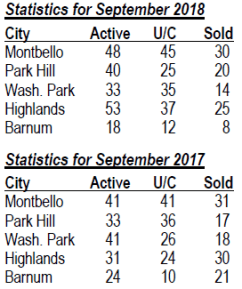 Since “all real estate is local,” I studied the active, under contract and sold statistics for five Denver neighborhoods which I chose for their diversity. At right are two charts, one for last month and the other for September 2017.
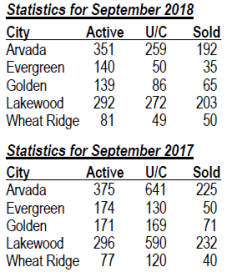 I also studied the active, under contract and sold statistics for various Jefferson County addresses. At left are the same two charts, one for last month and the other for September 2017.
 Last week I documented how our real estate market is showing signs of slowing. In that column I noted an increase in the number of price reductions for metro area listings and compared statistics from this summer with those from last summer, showing how the ratio of sold price to original listing price and the median days on market suggest a slowing in our real estate market.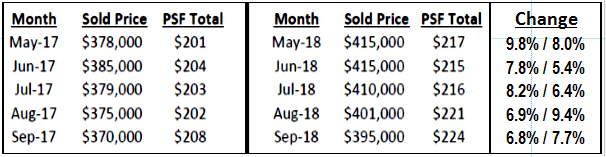
 Selling your home is no small matter, and small mistakes can lead to big losses. So who can you trust to do right by you or to give you sound advice? That’s what prompted me to start writing this column over a decade ago and why I archive all my columns going back several years at
  We had a great turnout of EVs and people interested in buying an EV at our event last Saturday. A special treat was the participation of four owners who brought their new Tesla Model 3s, three of which are shown in this picture. The one on the left had only 26 miles on the odometer, because the owner drove it straight from taking delivery of it that morning! During the event we received notification that lifetime free supercharging with a referral code for certain Tesla models is being discontinued after Sept. 16th — next Sunday! If you want to take advantage of that offer, you can use my own referral code, by going to this website URL:
  ough the often dreaded Homeowners Association (or “HOA”) has been around for a long time, its widespread use goes back only a few decades. Prior to, say, 1980, it was common for new subdivisions to have covenants, but no reasonable way to enforce them. This begs the question; “why have covenants if they can’t be enforced?” Enter the HOA, an entity designed and created to answer that question.
 Jim Smith's Blog