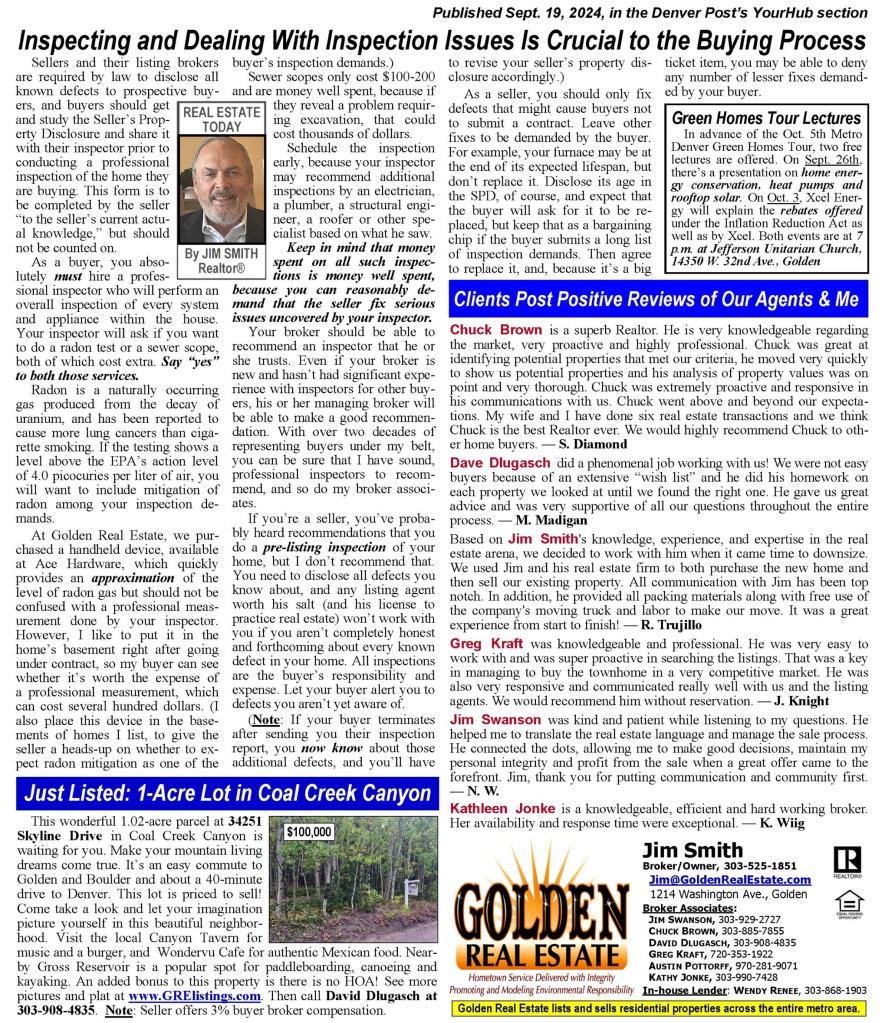
Click on this thumbnail to view a more readable and downloadable PDF of it.

Each element of the above ad is posted at http://RealEstateToday.substack.com with clickable links.
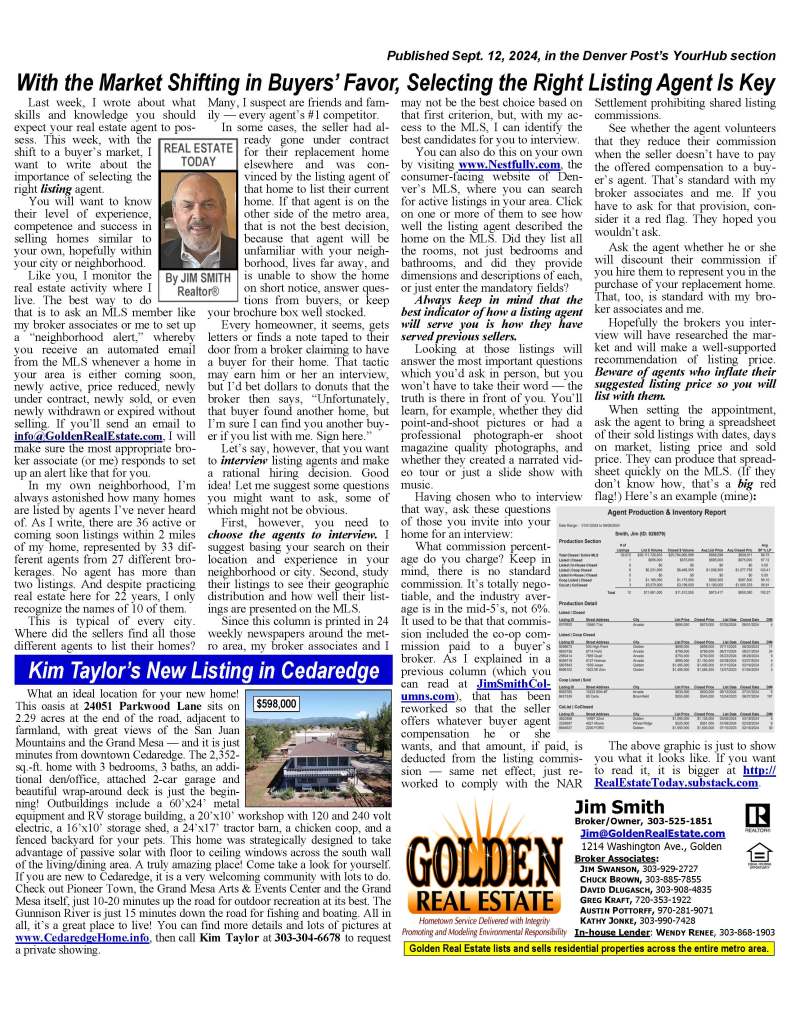
Click on this thumbnail to view a more readable and downloadable PDF of it.

Each element of the above ad is posted at http://RealEstateToday.substack.com with clickable links.

My archive of past columns can be found at https://www.jimsmithcolumns.com/. To receive each week’s column by email every Wednesday, send your request to Jim@GoldenRealEstate.com.
Click on the image below to be transferred to my Substack newsletter containing all elements of this week’s ad (and more).

Click on the image below to be transferred to my Substack newsletter containing all elements of this week’s ad (and more).

Click on the image below to be transferred to my Substack newsletter containing all elements of this week’s ad (and more). If you’re already receiving that Substack newsletter, Unsubscribe from this blog. This post is for those who are not already receiving the Substack newsletter.

If you’re not already getting my weekly column there, go to http://realestatetoday.substack.com and subscribe. See you there!


I have written often about geothermal heating and cooling. To remind you, by drilling either horizontally or vertically beneath your house or yard, you can use the 50-degree warmth of the earth, combined with a heat pump, to heat your home in the winter and cool it in the summer with minimal electrical energy to run a heat pump compressor.
The most common geothermal system involves several wells that are 300 feet deep, through which water or glycol is circulated to bring 50-degree liquid to a heat pump where it is heated to over 100 degrees in the winter or cooled to, say, 40 degree in the summer. Alternatively, you can install a horizontal loop over a wide area 10 feet below the surface and still get that 50-degree liquid for your heat pump to work with.
That’s called a “ground-source” heat pump system. More common (because it’s less expensive) is an “air-source” heat pump system, which warms or cools the outside air, extracting heat from outside air that can be as cold as zero degrees Fahrenheit. In the summer, the heat pump reverses its function and extracts heat from your indoor air, thereby cooling your home. The heating cycle requires more electrical energy for the air-source heat pump, especially when it’s really cold outside.
So geothermal is definitely the “gold standard” of household heating, but I’ve only seen it in a few homes because of its cost. I’ve visited homes in South Golden, Applewood and Centennial, plus single-family homes in the Geos Community in Arvada, that have geothermal heat pump systems.
Until I heard about ground-source heat pumps, the word “geothermal” brought to mind places like Iceland where volcanic rock is so close to the surface that you could heat your home without the additional input of a heat pump. (Cooling is another matter, of course.)
In Iceland, geothermal is used to create electricity from the steam created by that near-surface heat. I had assumed that running a power plant without such near-surface molten rock was impractical until I read an August 28th article in The New York Times which made me aware of progress being made using geothermal resources six miles or deeper underground to run power plants. The map below shows the temperature at 6.5 kilometers depth (~4 miles deep) in Centigrade, where 100º is the boiling point of water. According to the article , there is enough heat that deep to provide five times the total energy needs of our country — if it can be tapped. (That’s reminiscent of the claim that one hour of mid-day summer sun produces as much energy as the country’s entire electrical demand — if it can be tapped.)

Here’s another view:

Ironically, the tech breakthroughs of the oil and gas industry, especially fracking, are making it more practical to tap that geothermal energy. As Brad Plumer of the Times writes in his article, “by using advanced drilling techniques developed by the oil and gas industry, some experts think it’s possible to tap that larger store of heat and create geothermal energy almost anywhere.”
The U.S. Department of Energy, under which Jeffco’s National Renewable Energy Laboratory (NREL) operates, has created a Geothermal Technologies Office to advance what it has trademarked as the Enhanced Geothermal Shot™. (Here’s a link for their website. There’s a really effective minute-and-a-half video on that website explaining “Enhanced Geothermal Systems.”)
Plumer writes, “Dozens of geothermal companies have emerged with ideas. Fervo is using fracking techniques — similar to those used for oil and gas — to crack open dry, hot rock and inject water into the fractures, creating artificial geothermal reservoirs. Eavor, a Canadian start-up, is building large underground radiators with drilling methods pioneered in Alberta’s oil sands… The growing interest in geothermal is driven by the fact that the United States has gotten extraordinarily good at drilling since the 2000s. Innovations like horizontal drilling and magnetic sensing have pushed oil and gas production to record highs, much to the dismay of environmentalists. But these innovations can be adapted for geothermal, where drilling can make up half the cost of projects.”
What excites me about this effort is that because it utilizes the same drilling and fracking methodologies, to reach the hot rocks, it’s a more attractive transition for the oil and gas workforce, compared to training the workers to service wind turbines or install solar panels.
Sixty percent of Fervo’s employees, according to Plumer’s article, came from oil and gas, and oil companies and drilling-service companies are investing in the startups which are pioneering geothermal energy drilling in Utah and elsewhere. “Devon Energy invested $10 million into Fervo, while BP and Chevron are backing Eavor. Nabors, a drilling-service provider, has invested in GA Drilling, Quaise and Sage. In Oklahoma, a consortium of oil and gas firms led by Baker Hughes recently launched an effort to explore converting abandoned wells into geothermal plants.”
The “roadmap” created by the Energy Department’s Geothermal Technologies Office breaks down as follows:
I included that hard-to-read list only to reinforce what I said above, namely that this is the kind of work that’s a natural fit for the oil and gas industry. Instead of drilling for oil, they’re drilling for heat.
By the way, there are already 11 geothermal power plants operating along California’s Salton Sea.

This private, secluded townhome at 1120 10th Street #G in downtown Golden was just listed by Jim Swanson. The Tenth Street Row Home community has no HOA dues and minimal covenants. Walk one block to Clear Creek, Lions Park, tennis courts and baseball fields. The Golden Public Library is just a block further, and Washington Avenue, with its shops, restaurants and more, is just 4 blocks away! The Golden Rec Center is just 3 blocks in the other direction! The seller-owned solar system fully meets this townhome’s electrical demand and is included in the sale. This home has updated bathrooms, a large living room/dining room area, and bigger than average bedrooms. The primary suite has a private covered deck (visible in the above picture). The home has hot water baseboard heat and is cooled with a newer evaporative cooler. Partly visible above is the fenced 20’x20’ porch and garden area. This is a rare opportunity to live close to everything that makes Golden a great place to live. Take a video tour (with drone footage) below or at www.GoldenTownhome.info. The seller requested no open houses, so call your agent or listing agent Jim Swanson at 303-929-2727 to see it in person.


As you may know, Rita and I sold Golden Real Estate’s former office building on South Golden Road at the end of July. However, part of the contract of sale was that the buyers, Joe & Stacy Fowler of the Golden Hayride, would lease back to us a parking space for our free moving truck and the box shed which holds the free moving boxes we provide to clients.
The new location for the truck and shed is at the northwest corner of their parking lot at 17695 S. Golden Road. Here’s a picture:

We are super impressed with the changes which Joe & Stacy are making to the building and lot. Consistent with their Old West hayride motif, they have completely redone the inside, including installing wood laminate flooring and wood paneling that looks terrific!
Golden Hayride is a familiar site to Golden residents. Below is a picture of them and their truck, which is available for special events. You can catch one of their Beer Tours on their website, www.GoldenHayride.com. Here’s what’s on their calendar: Friday, September 29, Saturday, October 7, Saturday, October 14, Friday, October 20, Saturday, October 21, Saturday, October 28, Saturday, November 4, and Saturday, November 11.