Off-Market Transactions Hurt Sellers By Shutting Out Buyers Who Might Pay More

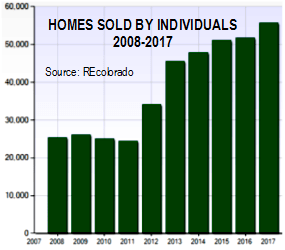
Real_Estate_Today_bylineAs I have written in previous columns, our limited inventory of active listings is due in part to sales that occur without the home being listed as “active” on the MLS.  This can be frustrating to buyers waiting for a house they like to come on the market, only to learn that it was sold off-market. Given the chance, some of those frustrated buyers might have paid more than the selling price, in which case both those buyers and the seller have been harmed.

For the past three years, up to 4% of the sold listings on the MLS were entered after they had sold. This January and February, 4.4% of the sold listings were entered after they closed, so it seems that the trend continues. REcolorado, our local MLS, has reason to believe that many additional homes are being sold off-market – often by MLS members – without being entered on the MLS at all.

Statistical analysis provides a clue as to how much money sellers might be leaving on the table by allowing agents to sell their homes without going “active” on the MLS.

Homes listed as sold on our MLS in January and February with zero days on market, sold on average for 99.7% of their median listing price, which was $375,000.  But homes with 1 to 4 days on market sold for 101.8% of their listing price. That’s a 2.1% differential, suggesting that if those off-MLS listings had been on the MLS at least one day, their selling price could have been $7,875 higher on average.

It’s reasonable to ask how listing agents may have profited from keeping listings off the MLS, because it certainly doesn’t appear as though their sellers did. An analysis of the listings that were entered as sold with zero days on market in January and February reveals that 37.5% of them were double-ended, meaning that the listing agent kept the entire commission instead of having to share it with a buyer’s agent. Homes which went under contract after 1 to 4 days on the MLS were double-ended at a much lower rate — under 5%..

This is not to say that zero days on the market is never in the best interests of the seller. For example, the seller and buyer might know one another, or otherwise found each other, and simply asked an agent to handle the transaction without seeking other buyers. Or perhaps it was a for-sale-by-owner (FSBO) property where an agent brought the buyer and entered the sale on the MLS after closing as a courtesy to other agents and to appraisers. Or a seller might not like the idea of opening their home to lots of strangers.

One would hope, however (and sellers should expect), that when a broker double-ends a transaction, he or she would at least give the seller a break on the commission, rather than keeping the portion (typically 2.8%) that would have been paid to a buyer’s agent. This practice is referred to as a “variable commission” and is office policy at Golden Real Estate. Unfortunately though, only 15% of listings on the MLS (my calculation) indicate that they have offered their sellers this discount. I’m pleased to report that 25% of the listings that sold in January and February with zero days on market — all of which were double-ended — specified a variable commission, saving money for the seller. However, that also means it’s possible, if not likely, that 75% of those sellers did not benefit from their agent’s double-ending the transaction.

The Colorado Real Estate Commission has expressed its concern about “coming soon” listings which could be used to increase the chances of a listing agent selling the property himself.  In a June 2014 position statement, the Commission stated that “if the property is being marketed as ‘coming soon’ in an effort for the listing broker to acquire a buyer and ‘double end’ the transaction, this would be a violation of the license law because the broker is not exercising reasonable skill and care.” Further, “a broker who places the importance of his commission above his duties, responsibilities or obligations to the consumer who has engaged him is practicing business in a manner that endangers the interest of the public.”

REcolorado rules require that a listing be put on the MLS within 3 business days of the listing agreement being signed. However, that rule does not apply when the seller instructs the agent (in the listing contract) not to put their home on the MLS.  As a member of REcolorado’s Rules & Regulations Committee, I have suggested that this rule be modified to state that the seller may instruct the agent to not make the listing active on the MLS, but they would still be required to enter the listing under a different status, including “under contract,” versus not entering it at all or waiting until after it closes. Currently, if those off-market sales are entered on the MLS at all, it is done only after closing. By showing a home as under contract, there’s at least the possibility that interested buyers could submit back-up contracts, which could serve the seller’s interest if the original contract falls.


Golden Real Estate Has Joined Good Business Colorado

Good Business Colorado strives for the sort of values we at Golden Real Estate hold dear. This non-profit group “advances the values of its business members by: 1) Advocating for local, state and federal policies that elevate our values; 2) Providing an alternative point of view to traditional business chambers in the media; and 3) Sparking the involvement of like-minded responsible businesses.”  Call me if this speaks to you as it does to me, and get involved!  Learn more at www.GoodBusinessColorado.org.


Buyers & Sellers Ask: Why Did the Appraisal Come in at Exactly the Contract Price?

Real_Estate_Today_byline     When purchasing a home with a mortgage, one of the major hurdles for buyers in getting to the closing table concerns the home appraisal. The lender hires the appraiser – at the buyer’s expense – to make sure that the home is worth what the buyer has agreed to pay for it.

More often than not, the appraisal comes in at exactly the contract price, which understandably seems a little fishy.  Typically, when the buyer asks me why, I explain that the appraiser always gets a copy of the purchase contract and therefore knows his or her target valuation. Once an appraiser can justify that target, there’s no need to identify additional value. That’s been my hypothesis anyway, but since it’s only a hypothesis, I posed the question last week to several experienced lenders with whom I have long-standing relationships.

Bernie Bernfeld of Wells Fargo (303-273-6373) responded as follows: “My short answer is that with so much scrutiny on appraisers and their valuations due to past abuses in some areas of the country, the appraiser will generally not assign more value than is necessary to support the sales value even if he knows the property may be worth more. This conservative approach satisfies the loan underwriters and those reviewing the appraisal while still supporting the buyer’s accepted offer.”

Jim Spray, a mortgage broker specializing in reverse mortgages (303-403-8168) said the following: “One should keep in mind that an appraisal is simply a valuation tool for lending purposes; it is nothing else. It may or may not reflect the actual market value,  which is what an independent party (the buyer, in this case) is willing to pay.  This may not reflect the value of an appraisal that is not associated with a purchase. In large part, an appraisal is just a tool for lenders to use to help prevent fraud and prove they are making sound lending decisions.”

Scott Lagge of Eagle Home Loans (303-944-8552) gave the longest response, making several interesting points.  He wrote: “Appraisals come in at value because appraisers don’t want to deal with appraisal objections from the real estate agents, their buyers and sellers, or the buyers’ lenders.

“When an appraisal comes in below the contract price, the first ones to cry foul are the real estate agents. They immediately question the appraiser’s ability, and put pressure on us lenders to fix it.  The agent send comps to the appraiser or lender, arguing their position, and wanting the lender to challenge the appraisal.

“So the extra work for the appraiser begins. They have to fix or defend their appraisal.

“Conversely, if the appraisal comes in high, especially if it comes in way higher than the contract price, there’s a concern on the part of the seller that they are leaving money on the table. This was more common in years past when sellers had access to the appraisal.  You can imagine being a listing agent in this situation. You’re selling a home for $400,000 and the appraisal comes in at $450,000. Bad deal for that seller — and for their listing agent!

“In either of these situations, the pressure is being put back on the appraiser to fix it.

“Let’s be clear, all lenders have a legitimate process for challenging an appraisal, and we have to prove that there is a material defect in the appraisal in order to rebut it.  We all have an internal or external appraisal management company that assures everyone is coloring inside the lines.  In other words, only valid challenges are accepted these days, but that doesn’t eliminate the pressure on us as professionals to explain why the value came in low or high to the consumer.

“So, coming in at value is the appraiser’s only sure-fire way to avoid scrutiny from clients, lenders and agents, thereby avoiding the extra work of defending and/or redoing the appraisal.

“The easier answer is that a home is worth what someone is willing to pay for it in an arm’s length transaction.  If you have a contract price of $300,000 and a buyer and seller have agreed on that price, once that transaction closes and records, it is officially worth exactly $300,000 and becomes a valid comp for future transactions.

“So why would an appraiser state anything different than the contract price, assuming he can justify it?”

[End of lenders’ responses]

I found it necessary once to challenge a low appraisal, and I was successful.  It was for a Golden area purchase, and the appraiser was from Castle Rock and clearly didn’t have geographical competence, because he checked the box indicating that the housing market was “stable” instead of “rising,” which was obvious to anyone.  I was able to point out other factual errors, and the appraisal was recast at the contract price.

Any of the above mortgage lenders would be happy to answer your questions on this topic. Call them!


Time May Be Running Out on Getting a Low-Interest Mortgage

Buyers appear to be getting “off the fence” as they see mortgage rates beginning to rise. How costly can waiting be?

interest-rate-up     Even a fraction of a percentage point rise quickly adds up. According to realtor.com, on a $300,000 purchase with a 30-year fixed-rate mortgage and a 20% down payment, the difference between 4% and 5% is $142 a month. That’s more than $51,000 over the life of the mortgage.

According to the realtor.com article, it’s important to note that mortgage rates are still low. After falling from a high of 18.63% on Oct. 9, 1981 they averaged about 7% from the 1990s through the 2008 financial crisis.  They dropped below 5% for the first time in March 2009, before bottoming out at 3.1% on Nov. 21, 2012.

After those recent historic lows, average mortgage rates have now reached their highest levels in more than four years. They hit an average 4.43% for 30-year, fixed-rate loans as of March 1, according to data from Freddie Mac. This is the highest they’ve been since Jan. 9, 2014, when they averaged 4.51%.


How Can Sellers Prepare for the Buyer’s Inspection? Here’s Some Practical Advice

Real_Estate_Today_byline   There are two schools of thought when it comes to whether sellers should look for and address possible inspection issues prior to putting their home on the market.

One school of thought recommends hiring a professional home inspector to do a full-blown pre-listing inspection and fixing problems that are bound to become inspection issues.

I subscribe to an alternative school of thought. When I meet with sellers, I look for what I call “eyesores” — issues that are likely to draw the negative attention of prospective buyers during a showing. This could be wall damage, old carpeting (especially shag), damaged countertops, peeling paint or excessively worn hardwood floors — any number of things that are indicative of deferred maintenance.  Here are some other things I recommend doing before putting your home on the market:

>  Remove and label (with tape) all window screens, and store them in the basement or garage. Wash all windows, inside and out.

>  Use one of our free box trucks to move unneeded items from your home and garage to storage, the Salvation Army, Habitat ReStore or the dump.  If you’re going to use a professional mover, put  items you’re going to keep but don’t currently need into a moving company’s POD rather than a storage unit.

>  Clean the carpets, replacing those which can’t be made presentable by cleaning.

>  After a walk-through, my staging consultant and I will make other suggestions as to repairs or improvements that will help your home to show better.

What I typically do not recommend is a major repair, or improvements that aren’t obviously required.  For example:

>  Do not replace undamaged countertops with slab granite or other surfaces that may be in vogue.

>  Do not replace a 15- or 20-year-old water heater that works fine, just because it might be considered beyond its useful life.

>  Do not add central air conditioning or solar panels or make other improvements.

>  Do not replace double-pane windows that show limited signs of vapor seal failure (minor condensation between the panes).

Behind these recommendations is a simple principle. You have everything to gain and little to lose by leaving undone those repairs or improvements which make little or no difference to the average buyer on his or her first visit to your home.

Imagine, for example, you have two windows with minor vapor seal leaks that end up in a buyer’s inspection objection notice. That objection will probably include other items, both major and minor.  Let’s say, for example, that your home’s radon level measured above the EPA action level of 4 pico-curies per liter and that your furnace is emitting carbon monoxide — a telltale sign that your furnace’s heat exchanger has a crack in it.

Mitigating radon will cost about $1,000. Replacing the furnace will cost $3,000 or more.  Replacing the two windows will cost about $1,000.

Here’s why you should not have replaced the windows before listing your home: you’re now in a position to offer, for example, to mitigate the radon and replace the furnace but not replace those windows with minor vapor seal leaks. If you had replaced those windows prior to putting your home on the market, you wouldn’t have been able to use them as a bargaining chip, which could save you the $1,000 cost of replacing them. Of course, this is but one example of how the agents at Golden Real Estate can help save you money.  The same principle applies to other points of negotiation that might have been lost by making repairs ahead of time.

Sometimes agents will recommend buying a home warranty policy prior to putting a home on the market.  A home warranty costs $300 or so and covers most appliances in the house if the appliance fails within the first year after closing. (Home warranties do have copayments for repairs, typically about $50.)

I like to hold back recommending a home warranty to use when responding to the inspection objection.  For example, the water heater is well beyond its useful life but working fine, and the buyer wants it replaced.  I can usually get the buyer to accept a home warranty, saving my seller several hundred dollars, versus replacing an appliance that is working just fine.

Other practical advice I give to sellers includes the following:

>  Replace the furnace filter and vacuum the interior of the furnace cabinet. This could forestall the inspector suggesting that the buyer require professional cleaning and servicing of the furnace.

>  Install downspout extenders so that water from your roof is diverted away from your foundation.

>  Replace all burned out light bulbs. Otherwise the inspector might question whether your light fixtures are working.

>  Apply silicone spray to your sliding doors so they operate smoothly and quietly.

¨  Imagine yourself as a prospective buyer who’s seeing your home for the first time, and pay special attention to first impressions.  This includes your front landscaping and especially your front door.  If the door or frame is weather beaten or badly faded, have it repainted or re-stained so it looks fresh and clean. If your doorbell or doorbell button is broken, fix it.

Andrew Lesko    I was assisted on this article by broker associate Andrew Lesko, who has additional suggestions regarding condos and townhomes, which are his specialty. You can reach him at 720-710-1000. Or visit his website detailing 30+ condo & townhome communities at www.GoldenTownhomes.com.


You May Want to Pay off Your Home Equity Line of Credit

One of the changes in the Trump tax reform legislation was to remove the tax deductibility of HELOCs — Home Equity Line of Credit loans.

My contact at US Bank tells me that their lawyers say the interest is still deductible, but only if the money from the loan was used for home improvement. I used a HELOC to pay for hail damage repairs to my home and car, so I’m guessing that the interest on it will not be deductible starting this year.  If this is confirmed, Rita and I are planning to pay it off as soon as possible. You may want to do the same.

Are You Interested in Urban Farming? Here’s an Introduction and an Opportunity

Real_Estate_Today_bylineAn increasingly popular aspect of living sustainably is to engage in “urban farming.” As shown in another post today, we have an urban farm listing in Lakewood, and in a couple weeks we’ll have a second urban farm listing in Arvada.

In light of these two listings, I asked an expert to enlighten you (and me) on this topic. Her name is Elizabeth Buckingham, and she writes a terrific blog, at www.FindingQuietFarm.com.

Here’s what she sent me on this topic:

By ELIZABETH BUCKINGHAM, Guest Columnist

Until the global economy collapsed a decade ago, my husband Nicholas and I were working on private yachts in some of the world’s most glamorous places. He was a deckhand and dive instructor, and I was a chef. We had spent years travelling, and when we returned to Colorado, where I was born and raised, we knew we wanted a little space around us. We found a charming 1960s home in midtown Arvada on about one-fifth acre. In addition to built-in bookshelves and a wood-burning stove, the yard had mature, leafy trees and plenty of space for extensive vegetable and herb gardens, a chicken coop with run, and a beehive.

We’ve spent the past eight years building an exceptionally productive urban farm. Our largest vegetable plot benefits from variable shade; we use it for greens, such as lettuce, kale and spinach, plus garlic and Egyptian walking onions. The northern third, up against the shed, collects quite a bit more sun, so we often plant staked runner beans and eggplant there. The soil in this in-ground plot was in decent shape, but every year we amend it generously with mulch from our leaves and compost that we make ourselves along our southern fence. Whether in a backyard garden or a farm, soil is by far the most important component – it’s essential to take good care of it.

The shaded garden plot was useful, but we needed space for heat-loving summer vegetables, like tomatoes and peppers. Nicholas built two large raised beds, which we filled with a mixture of lush organic soil and worm-rich compost. The beds are light, loamy and easy to grow in. We also constructed five smaller raised beds, ideal for squash, potatoes, peas and flowers, and we’ve planted raspberry bushes and perennial herb beds, including sage, English thyme, oregano, chives, lovage and mint. Every year, we harvest hundreds of pounds of organic food from our backyard.

chickens2Nicholas repurposed some beautiful redwood and built a secure chicken house and run. Instead of flimsy, inexpensive chicken wire, which a hungry raccoon can easily pry open, he used heavy-duty hardware cloth – and buried it nearly twelve inches underground to deter digging predators. Thanks to its solid construction, we never lost a bird to predation, which is the major risk to chickens in an urban area. The hen house itself is thoroughly insulated, eliminating any need for dangerous heat lamps which can kill chickens and burn down structures. Backyard chickens are easy to keep; they need protection from the sun and predators, plenty of fresh water and good-quality food and a clean, safe place to nest and sleep. The eggs are unparalleled.

BeehivesTo bring more beneficial pollinators not only to our garden but also to the surrounding area, we also installed a Langstroth beehive. The bees have overwintered successfully for three seasons and each fall they provide us with about fifty pounds of our own local honey. They’re fascinating to watch, improve pollination in our crops as well as those nearby, and maintaining a beehive doesn’t take much work.

Soon we plan to relocate to a much larger piece of agricultural land, where we’ll start a small organic teaching farm focused on sharing our knowledge with others. We want to encourage everyone to pay attention to where your food comes from and to grow and cook as much of your own food as you can. It’s not as hard as you think, and you’ll be amazed at how much food you can grow and how much money you can save. And it can be done even in an urban area! For more about our journey, please visit www.FindingQuietFarm.com.

Here are more resources where readers can learn more about all aspects of urban farming:

www.Echters.com

http://www.FleischerFamilyFarm.com

http://www.TheGrowHaus.org

http://www.SlowFoodDenver.org

http://www.ColoradoBeekeepers.org

Learn More About Urban Farming

Does urban farming make sense for you? Find out this Saturday by attending a 90-minute class taught by Elizabeth Buckingham in the living room of our Lakewood urban farm listing. The fee is only $10. You can RSVP at Jim@GoldenRealEstate.com. or by calling Chuck at 303-885-7855. The class starts at 1pm on Sat., Mar. 3rd, at 2665 S. Eaton Place. You don’t have to be interested in buying this home to attend this informative class on urban farming.


Follow-up Regarding Last Week’s Article on Capital Gains Exemption

Last week I wrote about the capital gains exemption of $250,000 for single taxpayers and $500,000 for married taxpayers. I failed to mention (because I didn’t know) that a widow or widower has 2 years after the death of their spouse to sell their primary residence and still take advantage of the higher exemption amount. I thank the readers who brought that to my attention.


Have You Owned Your Home for a Long Time? Here Are Some Ideas on Limiting Your Capital Gains Liability

Real_Estate_Today_byline   If you bought your primary residence back in the 1960s or 1970s, there’s a good chance that you’ll be pushing the limits of the capital gains tax exemption when it comes time to sell.

Fortunately, the recently enacted tax reform bill retains the $250,000 exemption from capital gains tax for a single person, and the $500,000 exemption for a married couple. If you bought your house for, say, $30,000, in the 1960s, it’s quite possible that it’s worth 10 or 20 times that amount now, resulting in the possibility of capital gains taxation.

I am not a CPA or tax advisor, but I can share some of what I’ve learned about strategies to avoid capital gains taxation on the sale of your home.

If you’re a couple thinking that you might want to sell before you both die, consider selling before one of you dies, or your $500,000 exemption will be cut in half. Remember that you have to have lived in your home for at least two of the five years prior to sale date, in order to have that exemption, so if you recently moved into, for example, an assisted living facility, you’ll need to sell it within three years of your move or you’ll lose the exemption.

Do not add your heirs to the title of your home as a “joint tenant” with rights of survivorship.  Why not?  Because, although it may simplify the passage of ownership to them upon your death, it simultaneously adds to their tax liability.  This occurs because they inherit your original purchase price as their cost basis, whereas if they inherit the property through your will, the basis for them is stepped up to the fair market value of the home at the time of the inheritance. Again, this requires that you not move out of the house more than 3 years prior to passing.

If one of a married couple moves out, the $500,000 exemption is preserved by the other spouse as long as the absent spouse is still alive, providing the couple sells the house within 3 years of the last spouse moving out.

Again, I am not a tax advisor, and am only recounting what I have been told by tax and estate-planning professionals. Consult your own tax  professional before acting on anything I have said in this article. If you don’t have a tax advisor, I can help you find one.

If you’d like to know what your home is currently worth, or what it might sell for, call Golden Real Estate at 303-302-3636 for a free market analysis.  Our agents are also available to meet with you in your home.

If you’re considering moving into a senior community — whether independent living or assisted living — we know experts on such facilities, which are usually rentals.

Downsizing could take the form of moving into a low-maintenance or zero-maintenance condo, townhome or patio home, in which case we, as Realtors, can serve you ourselves. If you are worried about selling your current home and then not being able to find a replacement because of the low number of active listings, we have strategies for avoiding that situation. Call us for a free consultation.