
 When we established Golden Real Estate over 11 years ago, I came up with two mottos for our company which appear on all our yard signs. The mottos also appear on our newest moving truck that we provide free to buyers, sellers and community organizations.
I’ve written more than once about the second motto, “Promoting and Modeling Environmental Responsibility,” but this week I want to focus on the first one, which is “Hometown Service Delivered With Integrity.”
I recall how easily those two value statements came to me back in 2007, and now I can testify as to how we have lived up to both of them in the years since and how important and relevant they feel so many years later.
My own relationship to integrity derives from my New England upbringing and specifically the influence of my somewhat aristocratic father, Abbott Pliny Smith II. Dishonesty or lying had no place in our home. I can still hear Dad telling me, “Just because other people steal apples doesn’t make it right for you to steal apples.”
Dad taught me not to pretend to know things I didn’t know or claim to have experience I did not have. I recall one instance where following that advice really helped me. It was when I owned a typesetting company in New York called Journal Graphics. Because of my journalism training, I wanted to land the account with WNET to produce the transcripts for The MacNeil/Lehrer Report. But I had no experience with transcription and no current clients.
So I took the approach of actually transcribing one of their shows and delivering the transcript to the station the following morning with a cover letter to the executive producer saying I could do this every night overnight, including printing. A month later I was in the office of the woman in charge of transcripts, and she said, “Yes, and would you like to do Bill Moyers’ Journal, too?”
I responded, “Let me do Bill Moyers’ show first, since it’s a weekly show, and once we’ve got that going smoothly, I’ll do the MacNeil/Lehrer Report, which is daily.” Then she asked if we’d do fulfillment. Without hesitating, I asked her, “What’s fulfillment?” She explained that it involves fulfilling the mailed-in orders. “That sounds very clerical, so I’m sure we could handle it,” I said. She then asked if we’d hire the two elderly volunteers who were doing that job for WNET, and I said, “Sure.”
Within a few years, we were doing all the transcripts for ABC News, Oprah Winfrey (and countless other daytime talk shows), 60 Minutes, CNN 24 hours a day, and all NPR programs. And it all started by demonstrating I could do the job, but also being honest about my lack of experience or clients. And I didn’t solicit thosse additional clients. ABC asked WNET, Oprah asked ABC, and the rest called us as Journal Graphics became a household name at the end of those other shows.
Fast forward to my real estate career. In 2012, mass emails claimed that the Affordable Care Act included a 3.8% sales tax on the sale of every home. It was an outright distortion of a tax that applied only to investment income and only on Adjusted Gross Income in excess of $200,000 in a given year. The email, which became viral as recipients forwarded it to all their contacts, was designed, using false information, to whip up grass roots hatred of Obama during his 2012 re-election campaign.
Recipients of the email were advised to sell their homes before the tax took effect in January 2013. The headline on my October 18, 2012, column was, “If You’re Selling Your Home Because of an ‘Obamacare Tax,’ You’ve Been Duped.”
At first, I figured it must be an innocent and unintentional misreading of the law, and I replied “All” to each email with the facts. But facts didn’t matter, and the emails continued in hopes of defeating Obama. This lack of integrity appalled me, but nowadays that lack of integrity is magnified by the use of social media, and the manipulation of voters continues unabated. Does it shock and dismay you as much as it does me?
Another wake-up call for me was that at least one of my own agents who received the mass email did not want to respond to it with the truth because she didn’t want to “be political” and thus alienate prospective clients.
One reason I was drawn to joining Rotary was its “Four-Way Test of the things we think, say or do.” I have published the Four-Way Test before, but I’ll repeat it here, and I urge you to consider whether certain politicians would pass those tests of the things they think, say or do:
“First, is it the Truth?
Second, is it Fair to All Concerned?
Third, Will it Build Goodwill and Better Friendships?
Fourth, Will it Be Beneficial to All Concerned?”
Boy Scouts can tell you that the Scout Law also includes telling the truth in the first of its 12 laws.
Realtors subscribe to the Realtor Code of Ethics. Article 12 says that “Realtors shall be honest and truthful in their real estate communications and shall present a true picture in their advertising, marketing, and other representations.” Sadly, however, I recently reported on one Realtor whose business model includes misleading homeowners with notes taped to their front door saying “I may have a buyer for your house.” Not only does that Realtor not have a buyer, but he admitted to me that when he gets one, he refers the buyer to another agent and earns a referral fee.
A common lapse of integrity by real estate agents is the exaggeration of their success. In past columns I have advised readers on how they could verify an agent’s record, and I even created a shortcut, www.FindDenverRealtors.com, which takes readers directly to the page on Denver’s MLS where they can get that information.
So, yes, within my own industry I also confront a lack of integrity. But Golden Real Estate’s motto is to practice “Hometown Service Delivered With Integrity” and I hold my nine broker associates to that commitment. Indeed, I can think of four broker associates I fired for reasons related to their lack of integrity. Please let me know directly if you ever sense that I or one or my broker associates has not lived up to that commitment.
If You’d Like My Political Take…
This column is about real estate, not politics, but, as you might suspect, I have a lot to say about integrity in politics. You’ll find that content at www.JimSmithBlog.com.
 It was reported last Wednesday that the 11-county Denver metro area real estate market had cooled dramatically in September. However, my research of the 5-county metro area on REcolorado.com (Den-ver’s MLS) did not confirm that.
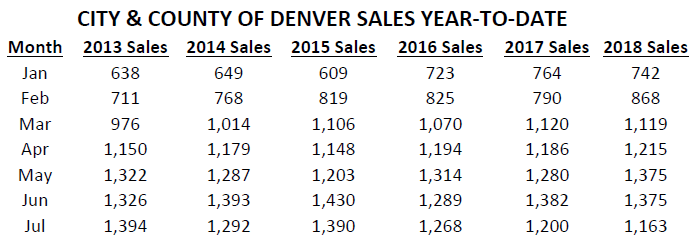
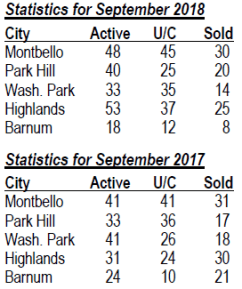 Since “all real estate is local,” I studied the active, under contract and sold statistics for five Denver neighborhoods which I chose for their diversity. At right are two charts, one for last month and the other for September 2017.
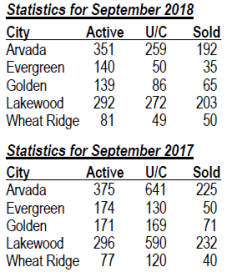 I also studied the active, under contract and sold statistics for various Jefferson County addresses. At left are the same two charts, one for last month and the other for September 2017.
 Last week I documented how our real estate market is showing signs of slowing. In that column I noted an increase in the number of price reductions for metro area listings and compared statistics from this summer with those from last summer, showing how the ratio of sold price to original listing price and the median days on market suggest a slowing in our real estate market.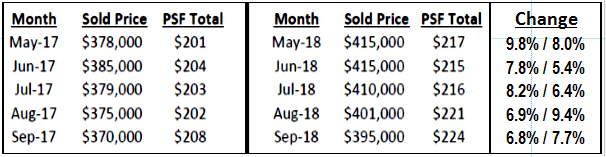
 Selling your home is no small matter, and small mistakes can lead to big losses. So who can you trust to do right by you or to give you sound advice? That’s what prompted me to start writing this column over a decade ago and why I archive all my columns going back several years at
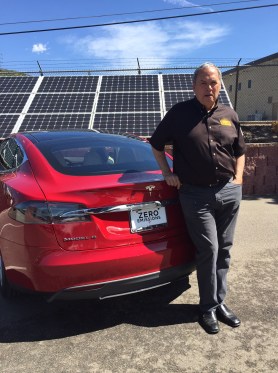
 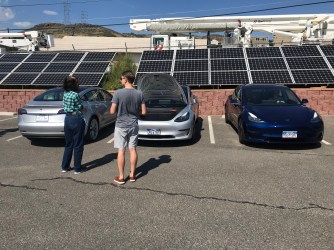 We had a great turnout of EVs and people interested in buying an EV at our event last Saturday. A special treat was the participation of four owners who brought their new Tesla Model 3s, three of which are shown in this picture. The one on the left had only 26 miles on the odometer, because the owner drove it straight from taking delivery of it that morning! During the event we received notification that lifetime free supercharging with a referral code for certain Tesla models is being discontinued after Sept. 16th — next Sunday! If you want to take advantage of that offer, you can use my own referral code, by going to this website URL:
  ough the often dreaded Homeowners Association (or “HOA”) has been around for a long time, its widespread use goes back only a few decades. Prior to, say, 1980, it was common for new subdivisions to have covenants, but no reasonable way to enforce them. This begs the question; “why have covenants if they can’t be enforced?” Enter the HOA, an entity designed and created to answer that question.
 By now it should be clear to you — as it is clear to the automotive industry — that electric vehicles are neither a passing fad nor something that only the wealthy can afford.
 Drive Electric Week, presented by Plug-In America, the Sierra Club, and the Electric Auto Association, is your opportunity to meet and talk with current owners (not dealers) of electric cars, get your questions answered, and even take a ride in one or more models.
 When I was a new agent at Coldwell Banker, my trainer shared the expression “listors last.” In other words, our goal should be to succeed as a listing agent, even if we get our first paychecks by representing buyers. But how does one get listings? You can solicit your “sphere of influence” (i.e., friends and family), but that can take you only so far. You can hold open the listings of busier, established agents who either can’t or don’t want to hold their own listings open, hoping that an unrepresented buyer comes along who also needs to sell their home but hasn’t yet hired a listing agent.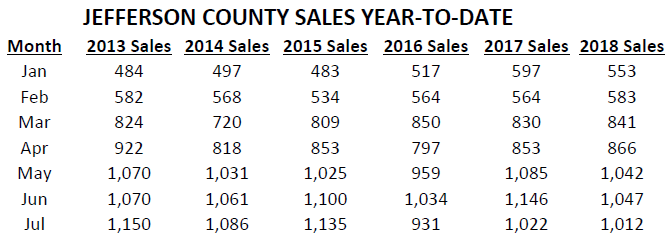
 Jim Smith's Blog